
The market already tells you this isn't a side experiment. The global AI in industrial automation market reached USD 20.02 billion in 2024 and is projected to reach USD 90.28 billion by 2033, growing at a CAGR of 18.6% according to Grand View Research's AI in industrial automation market report. If you run a factory, warehouse, processing plant, or asset-heavy operation, that number should reframe the conversation. AI for industrial automation isn't about chasing novelty. It's about fixing expensive operational friction that your current systems still don't handle well.
Most founders and ops leaders make the same mistake at the start. They think about models, dashboards, and vendors before they define the business problem. That's backward. Start with what's hurting the P&L: surprise downtime, scrap, slow inspection, unstable throughput, maintenance chaos, or planners making decisions with incomplete context.
The companies that win with industrial AI don't rip out working automation. They use AI to make existing operations more adaptive, more observable, and less reactive. That's the practical path. It's also the safer one.
The Industrial AI Revolution Is Already Here
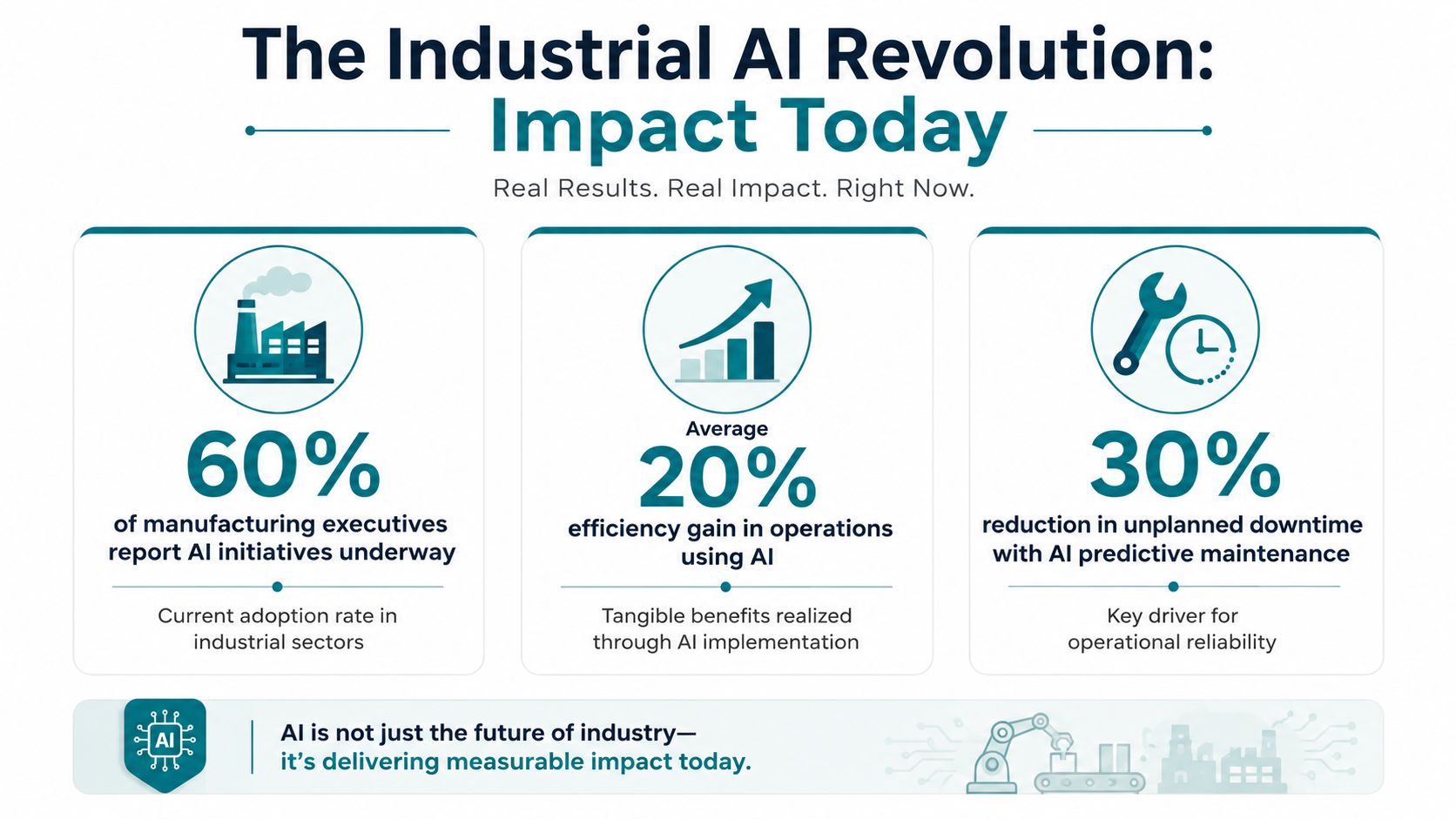
AI in industrial automation is on track to grow from USD 20.02 billion in 2024 to USD 90.28 billion by 2033, at 18.6% CAGR. Treat that as a market signal, not a trend piece. Capital is flowing into one type of project: systems that reduce downtime, stabilize quality, and improve throughput without forcing operators to replace the stack they already depend on.
The shift is significant because most industrial businesses still run on a patchwork of ERP, MES, PLCs, SCADA, spreadsheets, and operator judgment. Traditional automation handles repeatable logic well. It breaks down when conditions change, defect patterns drift, or asset behavior starts to degrade before a clear failure alarm appears.
What this changes for founders and ops leaders
Founders and ops leaders should treat AI for industrial automation as an operating improvement tool. Use it where fixed rules, thresholds, and manual reviews stop producing consistent results.
Three situations usually justify action first:
- Unplanned downtime: Your team needs earlier warning and better maintenance timing.
- Quality inconsistency: Manual inspection misses edge cases, especially at production speed.
- Process variability: Small changes in materials, settings, or environment create expensive swings in output.
Start narrow. Layer AI onto an existing workflow, prove the economics, then expand. A focused vision system inside a live inspection process is a better first move than a broad transformation program. This computer vision project for automated inspection and classification shows the kind of contained, workflow-level deployment that gets results without disrupting core operations.
Industrial AI earns budget when it solves a recurring operational problem faster, cheaper, or more consistently than the current process.
Why waiting is the wrong move
Delay has a cost. Competitors that add AI to maintenance, inspection, or process control improve decision quality first. They catch failures earlier, hold quality tighter, and recover faster when conditions shift.
That advantage compounds in the metrics that matter: lower scrap, fewer stoppages, better throughput, and more reliable delivery. The practical question is not whether AI fits industrial operations. The practical question is where you can apply it first, with the least disruption and the clearest payback.
Four Core Applications Driving Real ROI Today
There are plenty of use cases floating around. Most of them are too broad to be useful. In practice, AI for industrial automation earns trust in four areas where the economics are easy to see and the workflow fit is clear.
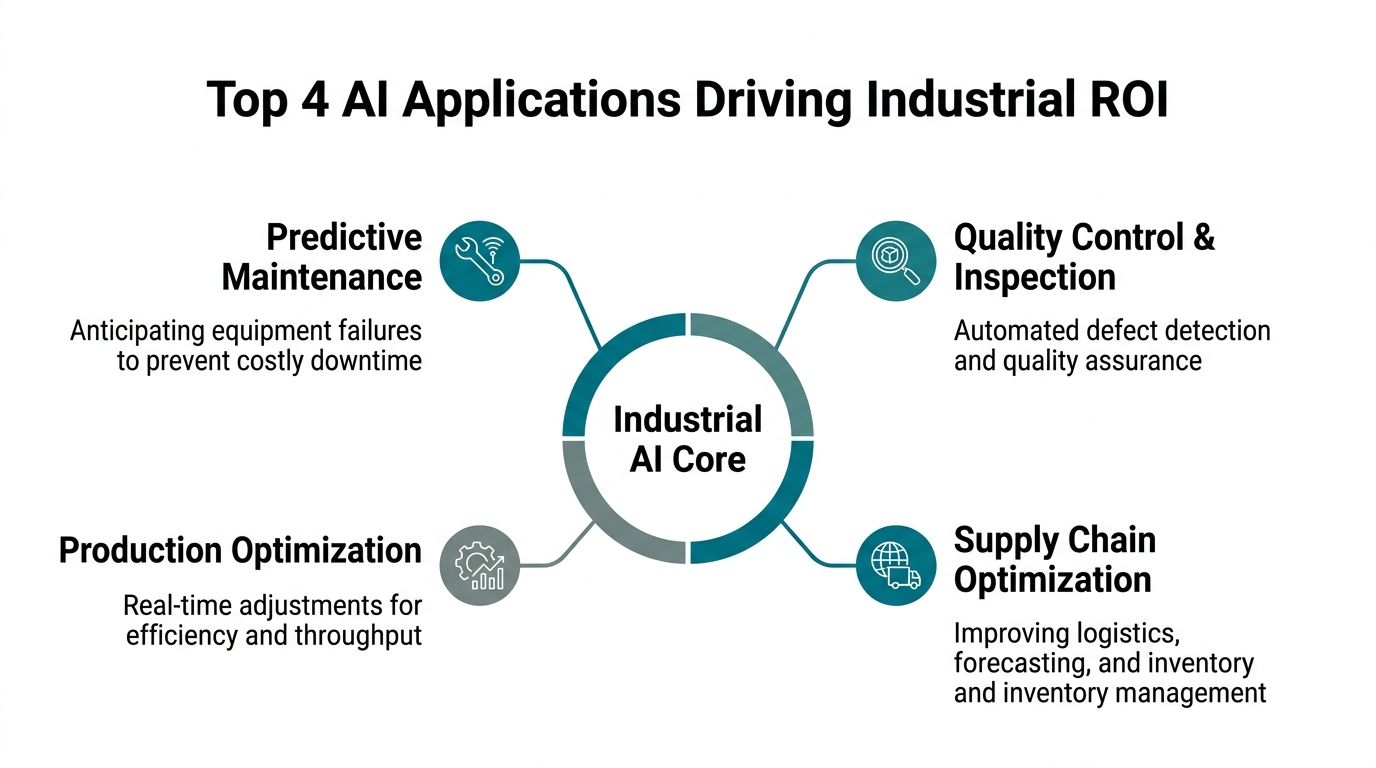
Predictive maintenance
Before AI, maintenance teams often work from static intervals, operator complaints, or obvious failure signs. That creates two bad outcomes. You either service assets too early and waste labor, or you service them too late and eat downtime.
After AI is layered in, you can use machine signals, maintenance history, and operating context to flag abnormal behavior earlier. The point isn't magical prediction. The point is better timing.
A strong first project usually looks like this:
- Choose one critical asset class: Compressors, pumps, CNC machines, or another bottleneck asset.
- Pull the data you already have: Sensor readings, alarms, maintenance notes, and downtime logs.
- Trigger action inside a real workflow: Create a maintenance review queue, not just another dashboard.
Quality control and inspection
This is one of the clearest wins because defects are visible and inspection labor is expensive. Before AI, human inspectors get fatigued, edge cases slip through, and consistency drops as line speed rises.
Computer vision changes that. According to CustomerTimes' manufacturing AI report, computer vision systems enhanced with generative AI achieve 98–99% defect detection accuracy by analyzing up to 10,000 unique defect patterns, and they can reduce labor costs by 50–70% in quality inspection workflows.
That matters most when the model is connected to action. Good deployments don't stop at “defect found.” They route the item, log the event, and help teams trace upstream causes. If inspection is your likely starting point, a focused computer vision solutions approach is usually more useful than a broad AI platform conversation.
Practical rule: If a vision model can't connect to reject handling, traceability, or rework, it's still a demo.
Process optimization
Some production losses don't come from broken machines or obvious defects. They come from drift. A line technically runs, but not at its best settings.
AI helps by spotting patterns across variables that operators can't reliably track at once. That includes temperature, pressure, material variation, cycle conditions, and environmental inputs. The result is usually better recommendations, tighter process windows, and less waste.
A useful way to view it:
| Before AI | After AI |
|---|---|
| Operators adjust based on experience and lagging output signals | Teams get earlier recommendations based on live process patterns |
| Process changes are reactive | Process changes become more deliberate and data-backed |
| Root causes stay fuzzy | Teams can isolate likely drivers of variability faster |
Smarter robotics and decision support
Industrial robotics already automates repetition well. AI becomes valuable when tasks are less structured. Picking mixed items, interpreting visual scenes, or adapting to minor variation all benefit from machine perception and classification.
This isn't about giving robots unrestricted autonomy. It's about adding intelligence where simple rules break down. If a robot cell struggles with variability in part orientation or visual identification, AI can improve the decision layer without touching the safety logic underneath.
The common thread across all four applications is simple. Start where the workflow is painful, the data exists, and the value of better decisions is obvious.
Building the Foundation Data and Technical Architecture
Most industrial AI projects fail before the model even matters. They fail because the data is fragmented, mislabeled, delayed, inaccessible, or disconnected from operations. Founders often assume they need more data. Usually, they need better-structured data and a cleaner path from machine event to business action.
Start with a data maturity audit
Don't ask, “Do we have data?” Ask sharper questions.
- Can you tie machine data to outcomes? If a defect occurs, can you connect it to product type, shift, line, operator action, or process conditions?
- Are timestamps reliable? If your logs don't line up, your model won't either.
- Do labels exist in usable form? “Failure,” “defect,” and “rework” mean nothing if every team defines them differently.
- Can your teams access the data without heroics? If every extraction needs weeks of internal negotiation, the project will stall.
A blunt assessment applies: Industrial AI doesn't need perfection, but it does need enough consistency to support decisions people will trust.
What good architecture actually looks like
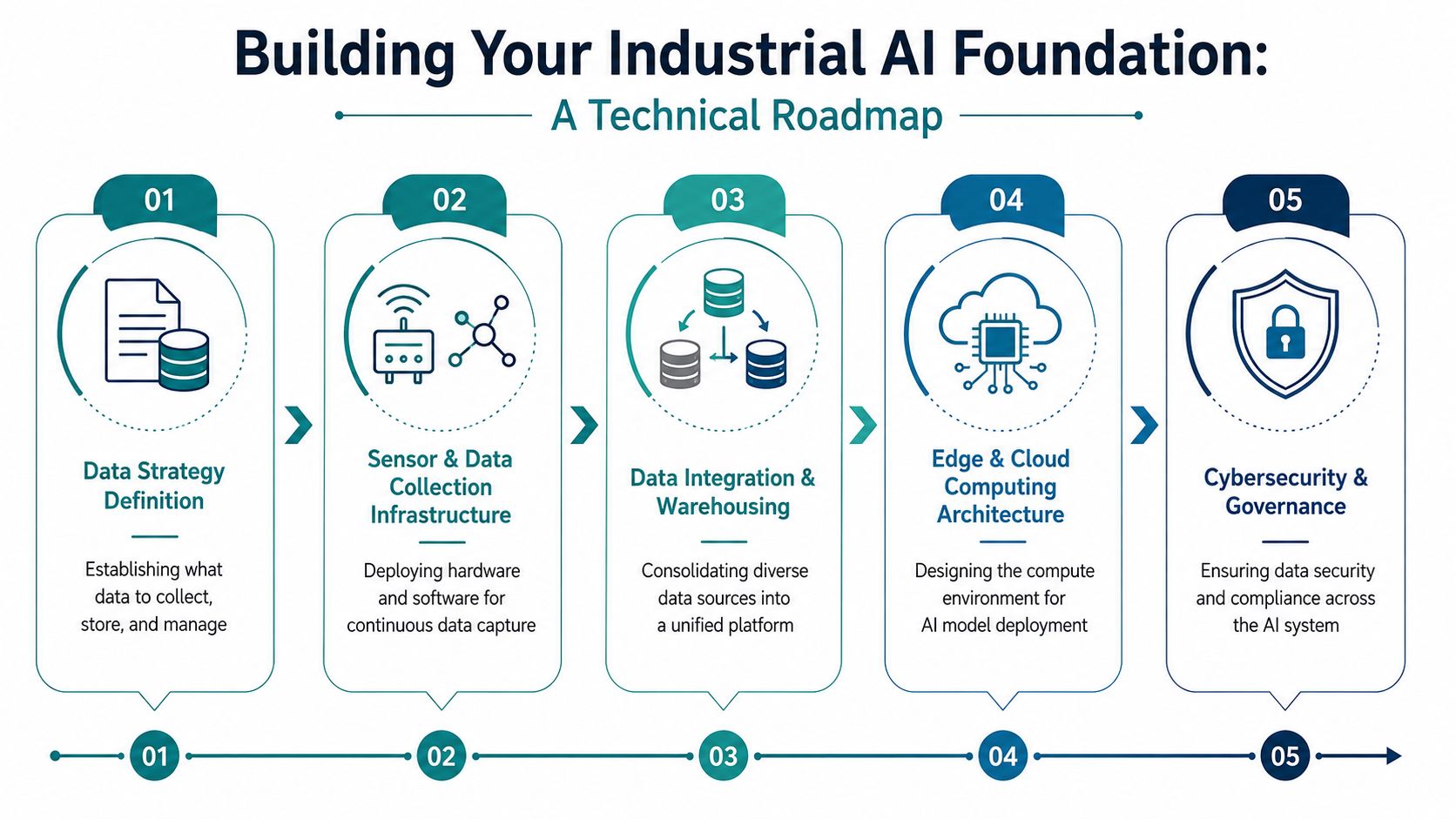
You don't need to become a systems architect, but you do need a working mental model. A practical stack usually includes these layers:
Data capture at the source
Sensors, PLCs, cameras, historians, MES records, maintenance systems, and quality logs.Data movement and integration
Pipelines that standardize tags, align timestamps, and combine machine data with business context.Compute and model layer
Edge systems for low-latency inference when decisions need to happen near the line. Cloud systems for training, monitoring, and broader analytics.Workflow delivery layer
SCADA screens, maintenance tools, operator interfaces, quality dashboards, or alerts inside existing systems.Governance and security layer
Role-based access, auditability, approval steps, and rollback paths.
The architecture mistake to avoid
A lot of teams build a technical science project instead of an operational system. They focus on model training and leave workflow integration for later. That's backward. If your prediction can't show up where a planner, operator, or maintenance lead already works, adoption will collapse.
The system isn't finished when the model runs. It's finished when someone on the floor can act on it without opening five tools.
For teams evaluating deployment patterns, this edge AI deployment perspective is a useful reference because it matches how industrial environments operate in practice. Some decisions belong close to the machine. Others belong in centralized analytics. Most serious setups end up hybrid.
A simple readiness checklist
Use this before you approve a pilot:
- One workflow only: Define the exact process you want to improve.
- One owner: Assign a business owner, not just a technical lead.
- One data map: List every system that holds relevant signals or events.
- One decision point: Specify what action changes if the model is right.
- One fallback path: Make sure operations can continue safely if the AI output is ignored or unavailable.
That foundation work feels less exciting than model demos. It's also what separates useful industrial AI from expensive theater.
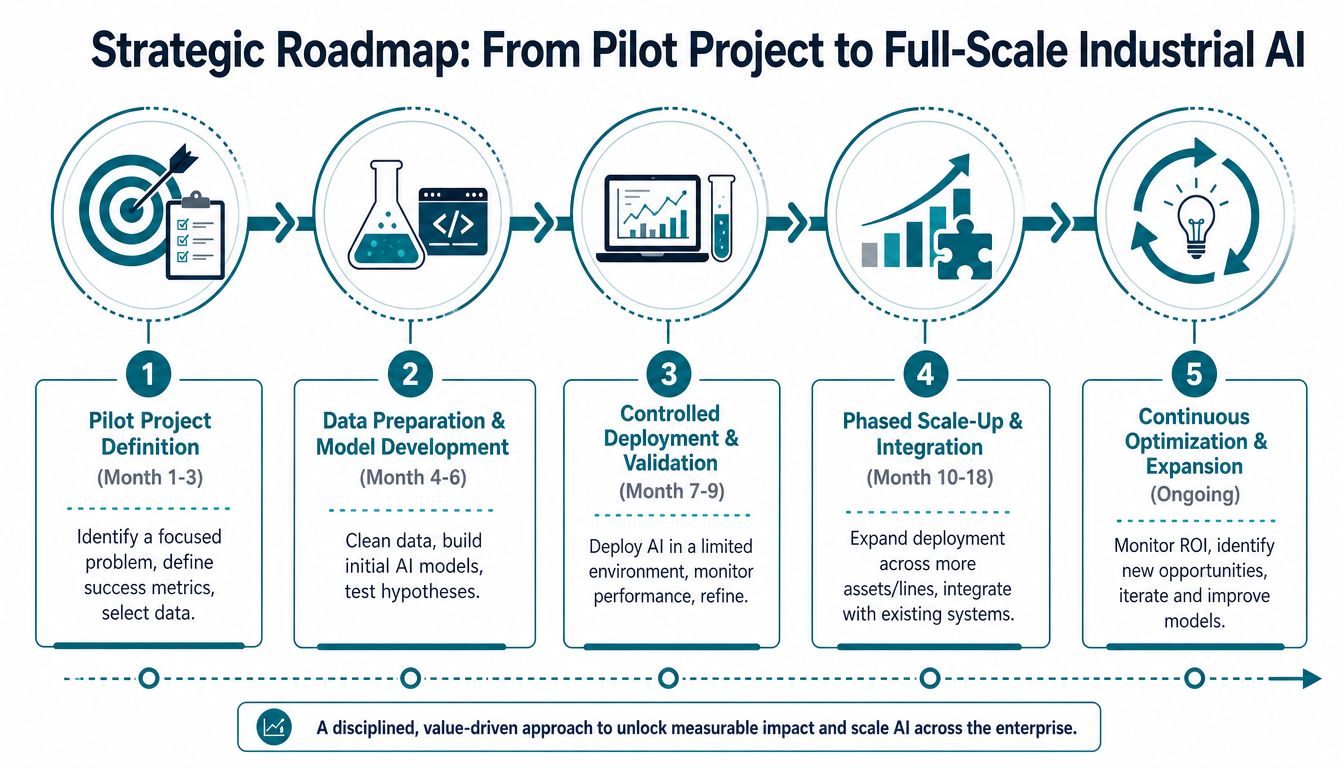
A Strategic Roadmap from First Pilot to Full Scale
The fastest way to waste money on AI for industrial automation is to launch a company-wide transformation before you've proven one narrow use case. Start smaller. Go narrower than feels comfortable. Then scale only after the pilot changes an operational outcome.
Pick a pilot that deserves to exist
A valid pilot has three traits. It solves a painful problem, the data is reachable, and the result can be measured without debate.
Good first pilots usually involve:
- A bottleneck asset with repeat failures
- A visible inspection point with scrap or rework pain
- A process step where drift hurts consistency
- A planning task where teams already rely on manual judgment
Bad first pilots usually sound impressive and vague. “Use AI across operations” is not a pilot. “Flag likely bearing failures on the packaging line and route alerts to maintenance review” is.
Layer AI on top of existing controls
This is the contrarian point many organizations need to hear early. Don't try to replace deterministic automation. The stronger pattern is to keep safety-critical logic fixed and place AI where uncertainty lives.
According to Codegeeks' guide to integrating AI in industrial automation, the highest ROI comes from layering AI as a decision-support system above fixed PLC rules, keeping safety-critical logic deterministic. That same source also notes that the biggest mistake is attempting to replace deterministic automation, while the safer pattern is adding intelligence only where uncertainty exists.
That should shape your rollout design.
Use a controlled rollout path
A smart deployment sequence is operational, not theatrical:
Shadow mode
Let the system generate predictions without changing production behavior.Human approval
Put recommendations in front of operators, planners, or maintenance teams and log what they accept or reject.Selective automation
Automate only narrow downstream actions once the team trusts the output and the failure modes are understood.
If your first rollout changes machine behavior before operators trust the recommendation, you're moving too fast.
Build a repeatable scale playbook
After the pilot, don't jump straight to enterprise rollout. Document what made the project work.
Create a scale playbook with these elements:
| What to document | Why it matters |
|---|---|
| Data sources and quality issues | So the next site doesn't repeat cleanup work |
| Workflow integration pattern | So adoption doesn't depend on one custom setup |
| Approval and escalation rules | So the operating model stays safe |
| KPI baseline and result logic | So finance can evaluate the next use case consistently |
| Ownership model | So no project gets stranded between IT, OT, and operations |
If you want a practical planning structure for that journey, this AI adoption roadmap is the right level of specificity. It focuses on phased implementation rather than broad transformation language.
Measuring What Matters AI KPIs and Your Business Case
Your CFO won't fund “better insights.” Your board won't care that the model scores well in a notebook. They care about fewer losses, lower cost, higher output, and stronger margins. So build the business case around business movement, not technical elegance.
The useful way to evaluate AI for industrial automation is simple. Tie every model output to a line item someone in finance already understands.
The KPIs that actually matter
According to Tribe AI's review of AI in industrial automation, companies that have successfully integrated AI into industrial automation workflows have achieved a 50% reduction in machine downtime, a 30% increase in labor productivity, and energy cost reductions averaging 21%.
Those are the kinds of benchmarks that get attention because they map directly to operating performance. Your first business case should center on a small set of measurable KPIs such as:
- Downtime reduction: The cleanest metric when one machine or line is the bottleneck.
- Labor productivity: Useful when AI reduces manual inspection, triage, or repetitive analysis.
- Energy cost impact: Relevant when process optimization affects consumption patterns.
- Scrap or rework trend: Especially important in inspection and quality projects.
- Throughput consistency: Best used when line stability is a recurring issue.
Translate the KPI into money
Don't overcomplicate ROI. Use plain operating logic.
- Downtime case: If a line is expensive to stop, reducing failure events has immediate financial value.
- Inspection case: If quality teams spend too much time on repetitive visual checks, automation reduces labor load and catches more edge cases.
- Optimization case: If process drift creates energy waste or inconsistent output, better recommendations improve margin.
Here's the discipline often overlooked. For every KPI, define four things before launch:
- Current baseline
- Target outcome
- Measurement method
- Financial owner who agrees the result matters
Without that agreement, every result turns into an argument after the pilot ends.
Avoid vanity metrics
A lot of industrial AI projects hide behind technical metrics because business metrics are harder. Don't let that happen.
Avoid leading with:
- model accuracy in isolation
- dashboard usage
- number of alerts generated
- number of data sources connected
Lead with changed outcomes. If the system generated alerts but downtime didn't move, the project didn't create value. If the model is technically elegant but operators ignore it, the value is still zero.
Board-level lens: Measure the improvement in operations first, then explain the AI that made it possible. Never do it in the reverse order.
A good business case is boring in the right way. It shows where money is lost today, what operational behavior will change, how success will be measured, and how quickly the organization can decide whether to expand or stop. If you want a structured way to frame that analysis, this AI ROI calculator approach is useful because it starts with cost drivers instead of model features.
Navigating Common Pitfalls Risks and Compliance
Industrial AI projects rarely fail because the model was impossible to build. They fail because the team picked the wrong problem, ignored data quality, skipped operator buy-in, or treated security and governance like cleanup work.
The most common ways teams derail the project
Here are the failure patterns I see most often, along with the fix that should have been in place from day one.
Starting with the technology
Teams buy a platform and then go hunting for a use case.
Mitigation: Pick one expensive operational problem first, then choose the tooling that fits it.Assuming data is “basically there”
The logs exist, but timestamps don't align, labels are inconsistent, and context is missing.
Mitigation: Run a data audit before you approve the pilot scope.Ignoring the shop floor
Leaders define the project in a conference room and expect operators to trust it later.
Mitigation: Involve the people who will use, validate, and challenge the output from the beginning.Creating pilot purgatory
The pilot works technically, but nobody planned ownership, rollout, or integration.
Mitigation: Define scale criteria before the pilot starts, not after it ends.
Risk management has to be operational
Industrial environments have a higher cost of error than most software environments. That means your AI rollout needs explicit controls.
A sensible risk posture includes:
- Human approval for sensitive actions: Especially early on.
- Audit trails: You need to know what the model suggested and what a human approved.
- Fallback procedures: If the AI layer goes offline, operations still continue safely.
- Role-based access: Not everyone should see or change everything.
- Change management discipline: Updates to models should be treated with operational seriousness.
Compliance and governance aren't optional
If AI touches quality records, maintenance actions, operator recommendations, or production decisions, governance matters. The exact compliance burden depends on your industry, but the principles don't change. Control access. Document outputs. Preserve traceability. Keep safety logic separate from probabilistic recommendations.
This is also where a lot of teams underestimate the politics. OT, IT, quality, and operations often have different definitions of acceptable risk. If you don't align them early, the project gets blocked late.
A practical governance checklist should answer these questions:
| Question | Why it matters |
|---|---|
| Who owns model performance in production | Ownership can't be shared into oblivion |
| Who approves workflow changes | AI changes process, not just software |
| What happens when the output is wrong | Teams need a clear response path |
| How are actions logged | Traceability supports trust and compliance |
| How do you roll back safely | Every deployment needs a controlled exit path |
The most expensive AI mistake in industry isn't a bad prediction. It's a bad prediction with no guardrails around it.
If you handle risk as part of the core design, not as a legal review at the end, you'll move faster and break less trust.
Your First Steps and Concrete Quick Wins
Industrial AI projects succeed or fail in the first few weeks. The teams that get traction pick one operational problem, use data they already have, and prove value inside a single workflow. The teams that stall start with platform demos, vague ambition, and no owner.
Start with an operating review, not a vendor shortlist. Identify one point in the process where you lose time, scrap, throughput, or engineering attention. Then confirm a simple fact: does the data already exist in your MES, CMMS, SCADA, historian, quality system, or maintenance logs? If the answer is no, don't force an AI pilot yet. Fix the data capture first.
The best early wins come from adding AI on top of systems your team already trusts. Keep the ERP. Keep the MES. Keep the existing quality workflow. Add a narrow layer of prediction, classification, or retrieval where a human decision is slow, inconsistent, or poorly documented.
Three quick wins worth testing
Historical maintenance log analysis
Choose one asset class with recurring downtime or expensive service events. Combine technician notes, failure history, work orders, and whatever machine signals are available. Your first goal is simple: identify patterns that should trigger earlier review, inspection, or parts replacement.
That gets you a practical pilot with a clear business case. Fewer unplanned stops. Better maintenance timing. Less tribal knowledge trapped in free-text notes.
Non-critical visual inspection
Pick one inspection step that does not sit inside a safety-critical control loop. Use existing images, defect examples, and operator decisions to test whether a vision model can classify issues with more consistency than the current manual check.
This works well as a first project because the workflow is narrow and the output is easy to compare against current performance. You learn fast whether your image quality, labeling discipline, and exception-handling process are good enough to support larger AI deployments.
Operator and quality knowledge retrieval
A surprising amount of production delay comes from people hunting for the right SOP, troubleshooting instruction, setup rule, or quality limit. A lightweight internal assistant connected only to approved documents can cut that search time and expose where your documentation is weak, outdated, or contradictory.
It also keeps risk low. The system supports decisions. It does not control equipment.
The decision framework to use now
Run every candidate project through five filters:
- The problem has clear financial impact
- The scope is narrow enough to finish in one quarter
- The required data is available without a major integration project
- A named team can act on the output
- Success can be measured in terms the plant manager and CFO will both accept
If a use case fails two of those tests, drop it.
Working with a consulting partner like AmasaTech can be practical at this stage, especially if they start with AI readiness, KPI definition, and pilot design instead of rushing into model development. That approach fits first industrial AI projects because it forces the business case, the data check, and the operating owner to be clear before any build starts.
Your first project should be boring in the right way. Narrow scope. Known users. Existing data. Measurable value. Get one pilot into production, prove the result, and use that win to fund the next layer.