
The market for AI in insurance claims processing is projected to grow at a 28.4% CAGR and increase by USD 1.39 billion between 2024 and 2029, with companies reporting up to 40% revenue increases from AI-driven personalization and efficiency gains, according to market coverage on Yahoo Finance. That changes the conversation.
AI for insurance claims support automation is no longer a side experiment for innovation teams. It's an operating model decision. If you're still treating claims AI like a chatbot pilot or a vendor demo, you're already behind the insurers building faster intake, cleaner routing, tighter fraud controls, and lower cost per claim.
Organizations often don't fail because the models are weak. They fail because they buy tools before they define the workflow, governance, and KPIs. If you want this to work, start with a business plan, not a model plan. A good place to align that thinking is a practical AI implementation strategy for enterprise teams.
The Inevitable Shift to AI Claims Automation
Claims is one of the few insurance workflows where AI can improve cost per claim, cycle time, and customer satisfaction at the same time. That combination is why this shift is already underway, and why waiting now carries a real operating penalty.
Treat this as an operating model decision. The insurers getting returns from AI are not buying generic tools and hoping teams adopt them. They are redesigning intake, triage, document handling, and exception management around clear service and cost targets. If your claims team is still built around manual handoffs, inbox monitoring, and repetitive review work, your unit economics will get worse as volume rises.
The essential change is simple. AI moves claims support from labor-heavy coordination to rules-driven execution with human review where judgment is essential.
Why the market has already moved
Executive teams do not need another debate about whether AI belongs in claims. They need a deployment plan tied to business outcomes. Start there.
Claims support automation gets approved faster than many other AI investments because the value is visible early. You can reduce intake delays, improve routing accuracy, cut document processing effort, and shorten status-update loops without changing every downstream system on day one. That is the right buying logic. Pick the workflow where friction is highest, set the KPI target, and deploy against it.
A strong AI implementation strategy for enterprise teams starts with that sequence. Business bottleneck first. Workflow design second. Model and vendor choices after that.
For insurance leaders, the priority metrics are straightforward:
- Cost per claim: Reduce manual triage, document sorting, and repetitive service work.
- Cycle time: Move claims from intake to assignment and decision faster.
- Customer experience: Cut waiting, handoffs, and inconsistent communication.
- Adjuster productivity: Shift human effort toward exceptions, severity, and judgment-heavy cases.
What executives usually get wrong
The common mistake is buying based on features instead of operational fit. A vendor demo shows OCR, summarization, fraud scoring, and a polished dashboard. None of that matters if the system adds another queue, breaks your controls, or fails to improve a metric your operations team already reports.
Use a stricter test. Can the system remove work from the current process? Can it fit into your claims stack without creating a shadow workflow? Can your team monitor quality, handle exceptions, and enforce review rules after launch?
Practical rule: Buy AI to fix one expensive claims bottleneck first. Expand only after you hit the target KPI.
The winners in claims automation are changing who does what. AI handles intake classification, document extraction, routine status responses, and next-step recommendations. Human experts handle ambiguity, escalation, negotiation, and coverage judgment.
That is why the shift is inevitable. The firms that adopt this model will run faster, serve policyholders better, and operate with tighter margins than the firms still staffing claims support as if volume and complexity have not changed.
Assess Your Readiness and Define the Strategy
Before you evaluate vendors, assess your readiness with brutal honesty. Most insurance AI projects stall long before model quality becomes the issue. The blockers are usually fragmented data, brittle systems, unclear ownership, and workflows nobody has fully mapped.
If your operation can't answer where claim documents live, how decisions are made, and who owns exception handling, you aren't ready to automate. You're ready to diagnose.
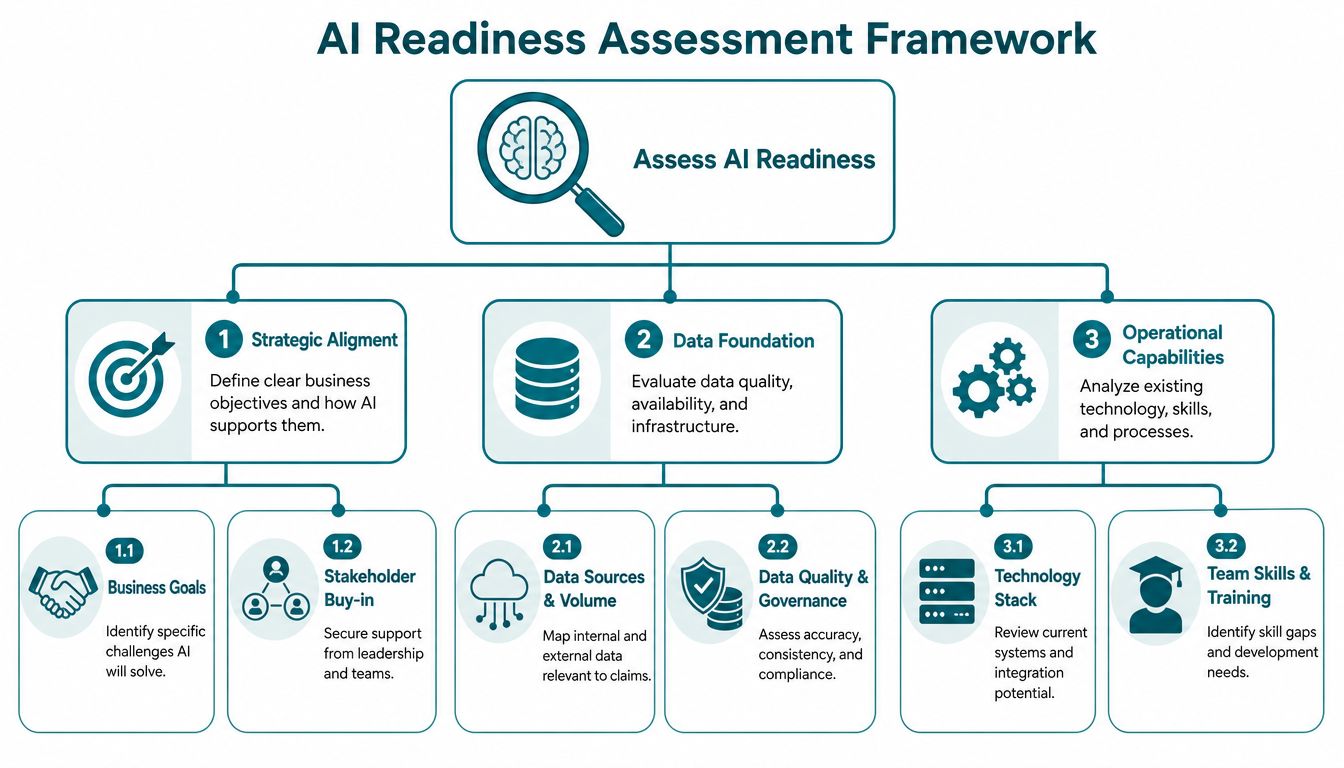
A structured AI readiness test for insurance organizations is the right first step because it forces alignment before procurement. That's the discipline often overlooked.
Audit the data first
Claims automation lives or dies on data quality. Not abstractly. Operationally.
You need to know whether claims data is centralized or scattered across a claims management platform, email inboxes, shared drives, adjuster notes, and third-party portals. You also need to know how much of that data is structured versus buried in PDFs, scanned forms, images, or narrative notes.
Ask these questions:
- Can you locate the core claims inputs? FNOL records, adjuster notes, supporting documents, photos, and policy references should be discoverable without manual hunting.
- Do you trust the data labels? If historical claim outcomes are inconsistent, your models will learn noise.
- Is governance defined? Someone should own retention, access controls, document naming standards, and auditability.
If your data is messy, don't treat that as a reason to wait. Treat it as the first workstream.
Check your systems for integration reality
A lot of insurers say they have modern systems because they bought a major platform years ago. That doesn't mean the stack is automation-ready.
Readiness depends on whether your current environment can exchange data cleanly with AI services. OCR, NLP, and workflow engines need reliable inputs and outputs. If your claims platform can't push and pull claim events, statuses, and extracted fields through APIs or stable integration layers, your pilot will turn into a manual workaround.
Use this quick diagnostic:
| Area | What to verify |
|---|---|
| Claims platform | Can it accept extracted fields, tags, and routing outcomes? |
| Document systems | Can scanned documents and attachments be programmatically accessed? |
| Communication tools | Can AI-triggered updates sync with customer service workflows? |
| Security layer | Can access be segmented by role and logged for review? |
You don't need a full rip-and-replace. You do need a realistic map of integration constraints before the project starts.
Assess the people side without sugarcoating it
Claims AI doesn't remove the need for adjusters. It changes what good adjusters spend time doing.
Your best adjusters often become your best AI validators because they know edge cases, fraud signals, and policy interpretation traps. But that only happens if you plan for it. If you position AI as a black box handed down by IT, frontline teams will resist it or work around it.
Key questions:
- Who owns the business KPI? Not the software. The outcome.
- Who validates model outputs? You need named reviewers.
- Who updates workflows after launch? If no one owns post-launch optimization, the pilot will decay.
The strongest insurance AI teams pair product-minded operators with claims experts. Technical teams alone don't know where adjudication breaks in the real world.
Map the process before you automate it
Never automate a vague process. Claims support teams often describe workflows at a high level, but exceptions, handoffs, and undocumented judgment calls are where projects fail.
Map the process from intake to closure and look for these friction points:
- Manual classification: Where do staff sort claims by type, severity, or urgency?
- Document chasing: Where do adjusters spend time requesting or organizing missing information?
- Routing confusion: Where do claims bounce between teams?
- Decision bottlenecks: Where does work wait for a person to review standard cases?
Start with a narrow, high-volume process that already has clear rules. That creates your first quick win and gives you evidence to justify broader rollout.
Set a strategy that is narrow first and expandable later
The right strategy is phased. Always.
Don't launch with a mandate to "automate claims." Launch with a target like reducing triage effort for one claim category, improving document extraction for one intake path, or speeding up routing to the right team. Then expand after you prove governance, quality, and ROI.
A practical readiness strategy has three parts:
- Choose one claims support problem with a clear owner
- Define the operational KPI before vendor selection
- Design for expansion from day one, even if scope stays tight
That's how serious teams approach AI for insurance claims support automation. They don't start with ambition. They start with control.
Map AI Use Cases to Business Outcomes
Most claims AI conversations often get sloppy. Teams list capabilities instead of choosing use cases. That leads to bloated roadmaps and weak ROI.
Use cases should be selected by business outcome, not by how impressive the demo looks. The right first use case is the one that removes friction from a measurable bottleneck in the claims journey.
By 2025, 60% of all insurance claims are expected to be triaged with automation, and leading insurers have achieved processing time reductions of up to 80% for simple claims, while damage assessment accuracy rates exceed 95%, according to this review of claims automation adoption and performance. Those numbers point to where the value sits. Early-stage intake, smart routing, and repeatable assessment work.
If you're evaluating generative AI solutions in insurance, don't start with "Where can we use GenAI?" Start with "Which claims KPI needs to move first?"
The four use cases worth prioritizing
Not every automation target deserves equal investment. In claims support, four use cases consistently matter most.
FNOL and triage
This is usually the most impactful starting point. AI can classify claim type, extract initial details, flag missing information, and route claims based on predefined logic.
The business problem is straightforward. Intake delays create downstream congestion. If the wrong team gets the claim, every later step gets slower. When triage improves, cycle time improves.
Primary KPI impact:
- Claim cycle time
- Time to first action
- Routing accuracy
This use case is especially strong when your operation handles large volumes of similar claims.
Fraud detection support
Fraud review shouldn't rely only on static rules. AI can surface suspicious patterns from structured and unstructured claim inputs, helping SIU teams and adjusters prioritize what needs scrutiny.
The business problem here is leakage. Teams either miss suspicious indicators or waste time reviewing too many false alarms. AI works best as prioritization support, not as an unsupervised final judge.
Primary KPI impact:
- Fraud indicator detection
- Investigator workload prioritization
- Claim review efficiency
Damage assessment
For auto, property, and other visually documented claims, AI can analyze photos and supporting documents to assist with severity estimation and review readiness.
The business problem is inconsistency. Manual image review creates delays and introduces variation across adjusters. When AI can structure image-based evidence early, the handoff to human review gets cleaner.
Primary KPI impact:
- Assessment turnaround time
- Assessment consistency
- Review workload
Use damage assessment AI where image quality, claim type, and decision rules are stable. Don't force it into workflows dominated by ambiguous evidence.
Semi-automated adjudication
This is not full autonomous settlement. It's decision support for standard claims where AI assembles evidence, checks policy conditions, summarizes documents, and recommends next steps for human approval.
The business problem is administrative drag. Adjusters spend too much time assembling context that should already be available. AI should reduce prep work before human review, not bypass judgment in edge cases.
Primary KPI impact:
- Adjuster productivity
- Decision preparation time
- Consistency of standard-case handling
A simple prioritization table
| Use Case | Primary KPI Impact | Core AI Technology |
|---|---|---|
| FNOL and triage | Cycle time, routing accuracy, time to first action | NLP, OCR, classification models |
| Fraud detection support | Fraud indicator detection, review efficiency | Machine learning, anomaly detection, document intelligence |
| Damage assessment | Assessment turnaround time, consistency | Computer vision, image analysis, document extraction |
| Semi-automated adjudication | Adjuster productivity, prep time, consistency | NLP, retrieval systems, policy-aware decision support |
How to choose what comes first
Don't choose based on trendiness. Choose based on workflow shape.
A good first use case usually has these traits:
- High volume: More repetitions means faster learning and clearer ROI.
- Low ambiguity: Standard claims are better pilot candidates than highly contested ones.
- Existing process pain: The best pilot fixes something teams already hate.
- Clear handoff rules: Human override must be simple and fast.
Some insurers should start with FNOL triage. Others should start with document-heavy claims support or damage review. The right answer depends on where manual effort is most concentrated.
Match use cases to executive KPIs
Founders and ops leaders don't need an AI roadmap. They need an operations roadmap with AI in the right slots.
Use this lens:
- If your biggest problem is slow intake, prioritize triage.
- If your biggest problem is review overload, prioritize adjudication support.
- If your biggest problem is inconsistent assessments, prioritize damage analysis.
- If your biggest problem is suspicious claim leakage, prioritize fraud support.
That's how you keep AI for insurance claims support automation grounded in business outcomes instead of vendor promises.
Select the Right AI Models and Technology Stack
Most executives hear a stack discussion and immediately get dragged into acronyms. OCR. NLP. LLMs. Computer vision. RAG. Orchestration. The mistake is thinking these are separate buying decisions.
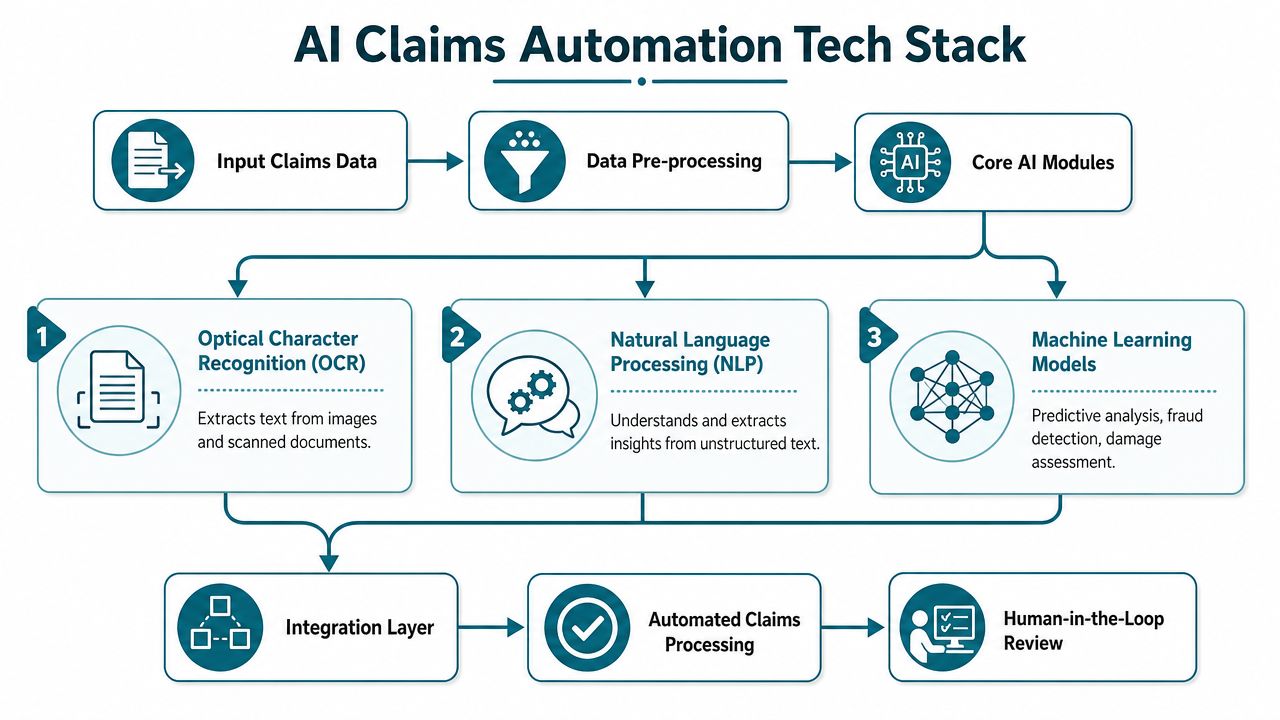
They aren't. They are components in a claims workflow. Your stack should be chosen by function. What data comes in, what needs to be extracted, what decision needs support, and where a human should step in.
What each layer actually does
Start with the boring but essential layers first.
OCR and document intelligence
OCR converts scanned forms, bills, handwritten inputs, and uploaded PDFs into machine-readable text. In insurance, that's table stakes. But basic OCR alone isn't enough. You also need document intelligence that can identify field types, classify documents, and preserve structure.
Use it for:
- Claim forms
- Repair estimates
- Medical records
- Police reports
- Supporting receipts and invoices
If your claims operation depends on emailed attachments and scanned documents, this layer matters more than the flashier AI components.
NLP and information extraction
Natural language processing turns narrative text into usable data. That includes adjuster notes, claimant descriptions, medical summaries, and legal or policy language.
Use it for:
- Entity extraction
- Claim categorization
- Narrative summarization
- Routing support
- Policy reference matching
This is what makes messy text operational. Without NLP, your team keeps reading unstructured material manually.
Computer vision
Computer vision handles visual evidence such as vehicle damage or property photos. It works best when the claim type is visually consistent and there is enough historical data to train or tune the models.
Use it for:
- Damage detection
- Severity support
- Photo-based review preparation
- Visual consistency checks
LLMs and retrieval systems
Large language models are useful for summarization, conversational interfaces, and policy-grounded recommendations. But they should not operate ungrounded inside claims decisions.
That's where retrieval comes in. A strong RAG pipeline architecture for enterprise AI lets the model pull from approved policy documents, playbooks, and claim guidelines before generating outputs. That reduces guesswork and makes decision support more defensible.
Buying advice: If a vendor is pushing an LLM without a retrieval layer, audit logs, and role-based controls, you're buying a demo, not production infrastructure.
Generic models versus insurance-grade models
Many buyers often waste time and budget. They assume a powerful general model will perform well enough across claims tasks. That assumption usually breaks under real claim documents.
According to McKinsey's discussion of AI in insurance, benchmark data from Aviva shows that deploying 80+ domain-specific AI models reduced liability assessment time for complex cases by 23 days, and generic models showed 10-20% lower accuracy in extracting nuanced data from unstructured reports than industry-specific models.
That gap matters. Claims work is full of domain language, edge cases, policy nuance, and messy evidence. Generic models can help at the surface layer. They usually aren't enough at the operational core.
What a production-ready stack should include
A practical claims automation stack usually needs these layers working together:
| Layer | Role in claims support |
|---|---|
| Ingestion layer | Pulls in forms, emails, images, and attachments |
| OCR and document intelligence | Extracts fields and classifies claim documents |
| NLP and classification | Structures narratives and routes work |
| Computer vision | Supports image-based damage analysis |
| Retrieval layer | Grounds outputs in policy and claims guidance |
| Workflow orchestration | Sends cases to STP, review, or escalation |
| Human review interface | Lets adjusters validate and correct outputs |
| Monitoring and audit layer | Tracks accuracy, exceptions, and drift |
What to avoid
Avoid stacks built around one oversized promise. "One model that does everything" sounds efficient and usually isn't.
Also avoid systems that hide confidence scoring or make it hard to inspect outputs. Claims leaders need to know why the AI routed a claim, extracted a field, or flagged a case. Explainability isn't a compliance accessory. It's an operations requirement.
The best technology stack for AI for insurance claims support automation is modular, observable, and grounded in insurance-specific data. Anything else creates risk you will pay for later.
Design and Launch Your Pilot Program
A strong pilot is narrow, measurable, and boring in the right ways. It shouldn't try to transform the entire claims function. It should prove that one workflow can improve without destabilizing the operation.
That means choosing a pilot scope with enough volume to matter and enough consistency to evaluate properly. Good pilot candidates include one claim category, one intake channel, or one support step like triage or document extraction.

Pick a use case with clean boundaries
The fastest way to kill a pilot is vague scope. "Claims automation for personal lines" is too broad. "Automated triage for one high-volume simple claim type" is workable.
A pilot should define:
- Input source: Where claims enter from.
- Claim type: Which claims are in scope.
- Output action: What the AI is allowed to do.
- Escalation rule: When a human takes over.
The narrower the boundary, the easier it is to validate accuracy, workflow fit, and exception handling.
Define success before building anything
Success criteria can't be invented after launch. They need to be agreed before model tuning starts.
According to Duck Creek's guidance on AI in insurance claims, a phased implementation should achieve a 90% human-AI agreement rate on specific claim types before full straight-through processing is enabled. The same source warns that skipping this step leads to a 15-20% increase in rework due to misclassified severity scores.
That should shape your pilot design immediately.
Use metrics such as:
- Human-AI agreement rate
- Routing accuracy
- Exception volume
- Manual review time saved
- Rework rate
Don't declare victory because users like the interface. A claims AI pilot wins when operational metrics improve without rework rising.
Build a human-in-the-loop workflow on purpose
Claims leaders sometimes treat human review as a temporary compromise. That's wrong. Human review is part of the design.
In the pilot phase, adjusters should validate outputs, correct mistakes, and feed those corrections back into the model and workflow rules. This does three things. It protects quality, builds trust, and creates the labeled feedback your system needs to improve.
A workable human-in-the-loop design includes:
- AI proposes a classification, extraction result, or routing outcome.
- An adjuster reviews the result in a lightweight interface.
- Corrections are captured in a structured way.
- The team analyzes errors weekly and updates prompts, rules, or models.
This is not overhead. This is how the pilot becomes production-grade.
Run the pilot like an operations program
The project owner shouldn't be buried in technical updates only. Pilot governance needs weekly operational review.
Focus the review on questions like:
- Which errors repeat most often?
- Which claims should have been excluded from pilot scope?
- Where are adjusters still doing unnecessary duplicate work?
- Which outputs need confidence thresholds tightened?
Also decide in advance what happens after the pilot. If it succeeds, what claim type expands next? What integration work is required? Who signs off on progression from assisted review to limited automation?
A pilot is not a proof of concept. It is the first controlled version of the operating model. Treat it that way.
Scale Govern and Optimize for Production
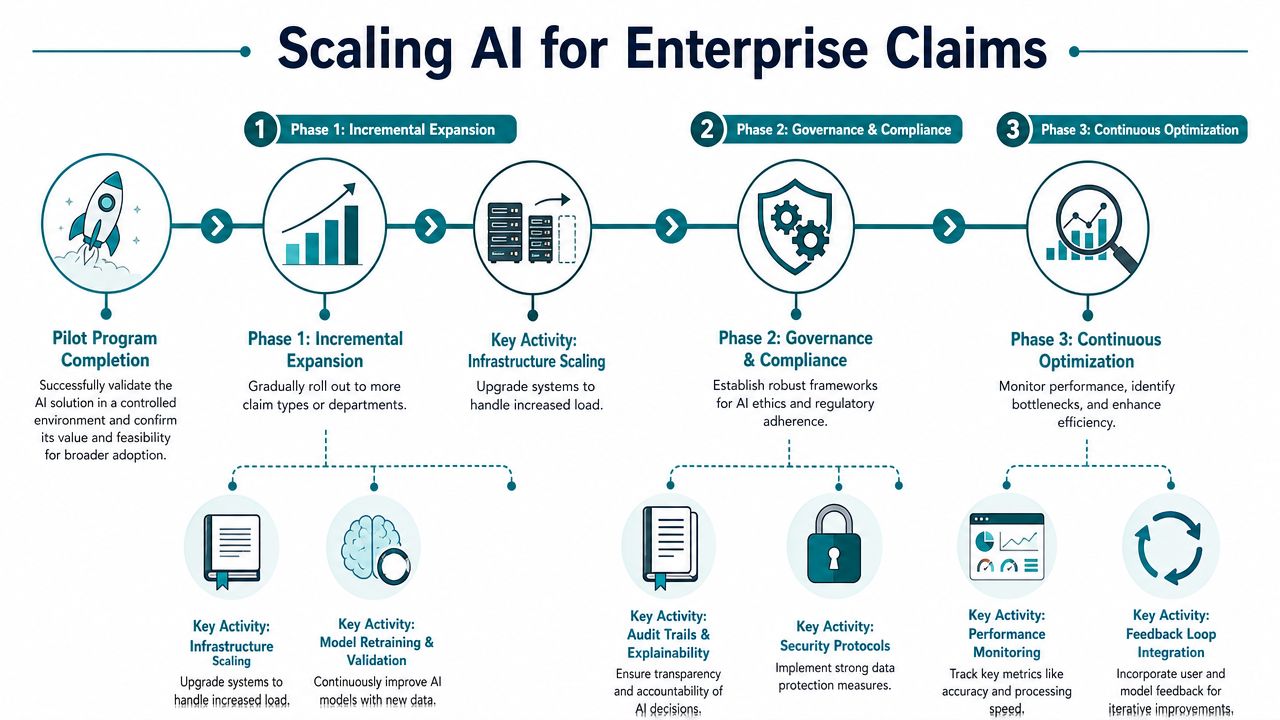
A successful pilot is not the finish line. Scaling into production exposes the work teams postponed on purpose during the test phase: integration debt, exception sprawl, weak monitoring, unclear ownership, and model drift. If you do not fix those now, performance drops as volume rises and adjuster trust erodes fast.
Scale by workflow family, not by enthusiasm
Production rollout should follow workflow similarity, not internal excitement. Expand from one validated use case into adjacent claim flows that share the same document types, business rules, review steps, and downstream systems.
That usually means this sequence:
- Add similar claim types first where intake formats and routing logic already match what the pilot handled.
- Reuse ingestion, extraction, and routing components across teams instead of rebuilding for each line of business.
- Keep one review experience so adjusters can work across workflows without relearning the system.
This is how insurers avoid a common scaling mistake. They do not fail because the pilot was weak. They fail because each new rollout becomes a custom build with different prompts, different exception handling, and different reporting.
Put governance into the operating model
Governance belongs inside daily operations. It keeps claims automation reliable, auditable, and worth funding.
At minimum, production governance should answer these questions:
| Governance area | What needs to be defined |
|---|---|
| Ownership | Who owns model performance, workflow rules, and exception policy |
| Monitoring | Which KPIs are tracked continuously and who reviews them |
| Auditability | How decisions, recommendations, and overrides are logged |
| Change control | How prompt, model, and rule updates are approved |
| Escalation | What happens when outputs degrade or exceptions spike |
Many insurers need AI orchestration for enterprise workflows before they need another model. Claims support automation scales when systems, people, and decision rules are coordinated under one operating model.
Production AI is a managed operational capability. If nobody owns post-launch performance, the system degrades quietly until the business loses confidence.
Monitor drift and optimize continuously
Claims operations do not stay still. Claim mix changes. Document formats change. Staff behavior changes. Production AI has to be reviewed the same way any other core operations process is reviewed.
Track the metrics that tell you whether the system is helping or adding work:
- Extraction quality
- Routing outcomes
- Override frequency
- Exception patterns
- Time saved versus time added
- Feedback from adjusters and supervisors
Do not limit optimization to model retraining. Some of the highest-impact fixes come from tightening automation eligibility, improving intake forms, refining retrieval sources, or changing escalation rules.
Use adjacent ROI opportunities to justify the platform
The best production programs do not stop at one workflow. They use the same AI infrastructure across multiple high-friction claims processes to improve payback and lower deployment cost per use case.
A strong example is health insurance claims denial resolution. It uses many of the same building blocks already created for claims automation: secure document ingestion, extraction, workflow routing, human review, and audit logging. If you already built that foundation for FNOL triage, document classification, or claims correspondence, you should extend it into adjacent workflows instead of funding a separate stack.
That is the executive test for scale. Are you buying isolated automations, or are you building a reusable claims operations platform?
The production mindset executives need
AI for insurance claims support automation should be managed like a standing operations capability with KPIs, owners, service levels, and review cadence. Teams that run it that way keep improving throughput, consistency, and customer experience after launch.
Use this standard:
- Fund governance early
- Treat feedback as structured training data
- Expand only after KPIs hold at production volume
- Build reusable infrastructure instead of isolated pilots
That is how a pilot becomes a durable claims advantage.
If you're evaluating AI for insurance claims support automation and want a partner that ties deployment to operational KPIs, AmasaTech helps insurers assess readiness, design phased pilots, and scale production-grade AI systems across document intelligence, custom LLM workflows, RAG, computer vision, and orchestration. The work starts with business outcomes, not hype.