
Your team already has leads coming in at all hours. The problem usually isn't lead generation. It's what happens in the first few minutes after a form fill, portal inquiry, website chat, or missed call. Someone on the team is in a showing, another agent is driving, and the prospect who was ready to talk moves on to the next listing or the next team.
That's why real estate teams keep looking for the best AI automation platform for real estate teams. They want better response speed, cleaner routing, less manual follow-up, and fewer leads dying in the CRM. They also want something agents will effectively use. That last part matters more than most demos admit.
The market has split into a few clear buckets. Some platforms are all-in-one systems that combine CRM, website, routing, and AI nurture. Others are specialist assistants that plug into the stack you already have. A third category focuses on on-site conversion, where AI works on your website to answer listing questions and route serious prospects before they bounce.
The top 10 tools below are ranked for real team use, not feature theater. I'm looking at where each platform is strongest, where it gets clunky, and which kind of team usually gets the fastest return. You'll see trade-offs around integrations, workflow control, security posture, and how much operational discipline each platform requires. If you're deciding between replacing your current stack or layering AI into it, this list should make that decision a lot simpler.
1. Follow Up Boss
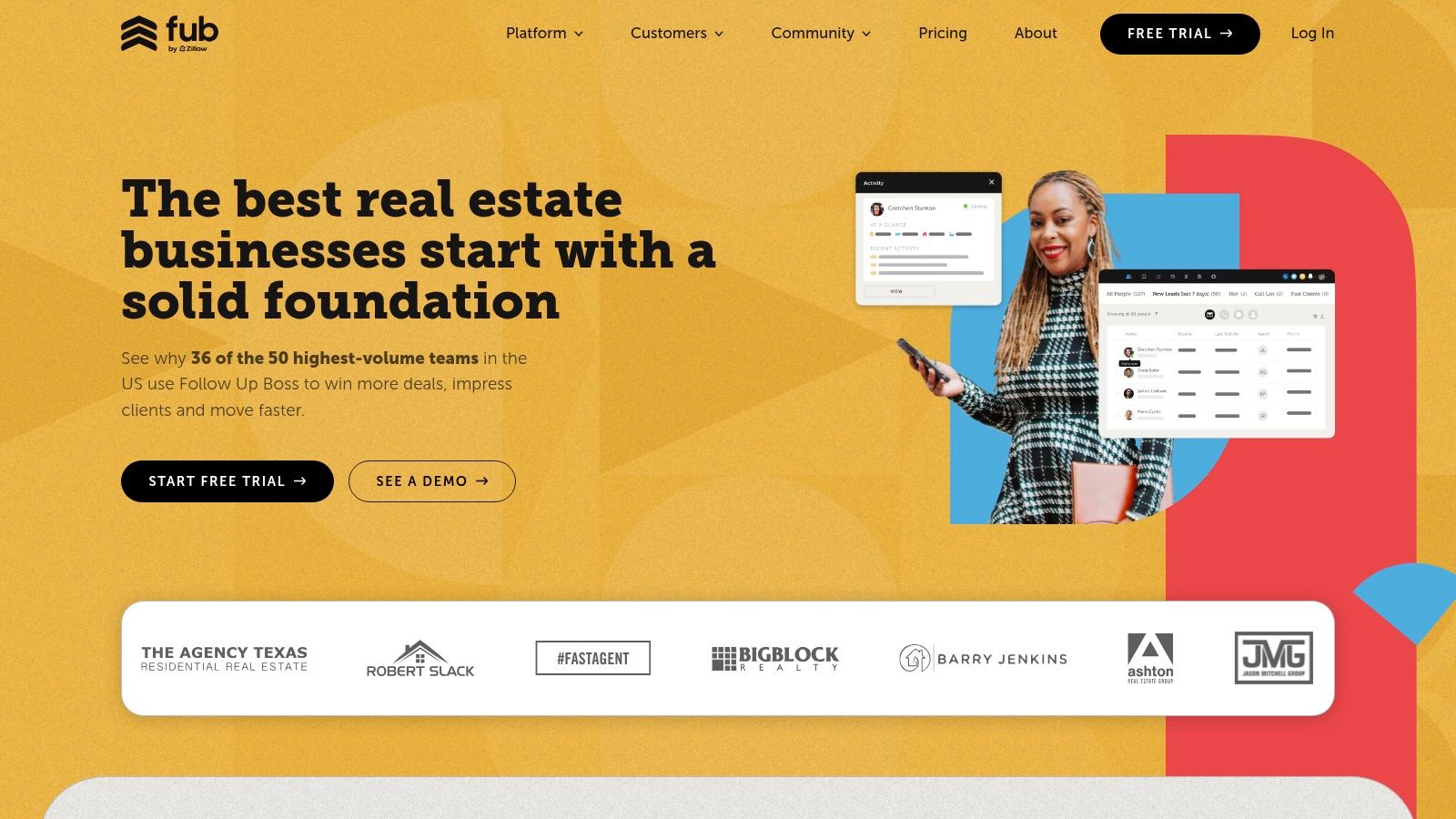
Follow Up Boss still earns a spot near the top because it solves a problem many teams have. They don't need another bloated “all-in-one.” They need fast lead routing, visible accountability, and follow-up that doesn't depend on every agent remembering the next step.
This is the platform I'd put in the “process-first CRM” category. Its strength isn't flashy AI. It's the fact that the AI sits inside a workflow teams already understand. If your managers care about lead response, call outcomes, handoffs, and agent activity, Follow Up Boss keeps that visible.
Where It Fits Best
Follow Up Boss works well for teams that already like their website, lead vendors, and maybe even parts of their marketing stack. It doesn't force a full rip-and-replace. You can run automations and Action Plans across email, text, and task follow-up, while keeping integrated calling, texting, a shared inbox, and team reporting in one place.
The newer AI features matter most when they reduce CRM friction. Auto-suggested CRM updates and workflow assistance are useful because they remove some of the “I'll log it later” behavior that kills reporting quality.
Practical rule: If your team's real issue is inconsistency, not top-of-funnel volume, Follow Up Boss is often a better bet than a heavier platform.
What Works and What Doesn't
What works is adoption. Agents usually learn it quickly, and leaders can inspect performance without digging through five dashboards. That's a big reason teams pair it with outside implementation support from an AI workflow automation agency when they want tighter lead handling without rebuilding the whole operation.
What doesn't work as well is texting flexibility in some automation scenarios. You'll want to map out your drip logic before assuming every text sequence behaves the way email automation does. There's also no native IDX website, so it is often paired with another website provider.
Best for: Teams that want a CRM-centered operating system
Less ideal for: Teams looking for website, ads, and nurture under one vendor
2. Ylopo
Ylopo belongs in a different category. It's not just a CRM with some AI layered in. It's a full-funnel marketing and nurture engine built around paid traffic, IDX behavior, retargeting, and AI-driven conversations.
If you're serious about round-the-clock lead engagement, Ylopo is one of the more mature specialist platforms. The biggest appeal is that AI Text and AI Voice work together, not as disconnected modules. That matters when a lead ignores a text but answers a call, or vice versa.
Best for Teams Buying Attention at Scale
Ylopo is strongest when you're already spending on ads and you want the follow-up engine tied directly to how prospects behave. Listing views, portal activity, return visits, and other buying signals can shape outreach instead of forcing everyone into the same generic drip.
That's the difference between static automation and behavioral automation. The latter usually feels more human because the message matches what the lead just did.
The only hard pricing point I'm comfortable citing is that Ylopo is noted for AI-powered lead generation starting at $395/month plus ad spend. Beyond that, teams should expect the total cost picture to depend on add-ons and usage.
The Trade-Off Most Teams Miss
Ylopo tends to work best when you buy into more of its ecosystem. That can be a strength or a limitation.
- Strong fit: Teams that want ads, remarketing, IDX, and AI nurture aligned in one system
- Weak fit: Teams that only want a lightweight AI assistant layered on top of an existing stack
- Operational reality: Someone still has to own campaign strategy, lead routing, and conversation review
A lot of teams look at Ylopo when they're moving toward more autonomous outreach. If that's where you're heading, it helps to understand broader agentic AI workflows in real operations, because the tool is only part of the system.
Ylopo is powerful when you treat it like a revenue engine, not a set-it-and-forget-it texting bot.
3. Chime
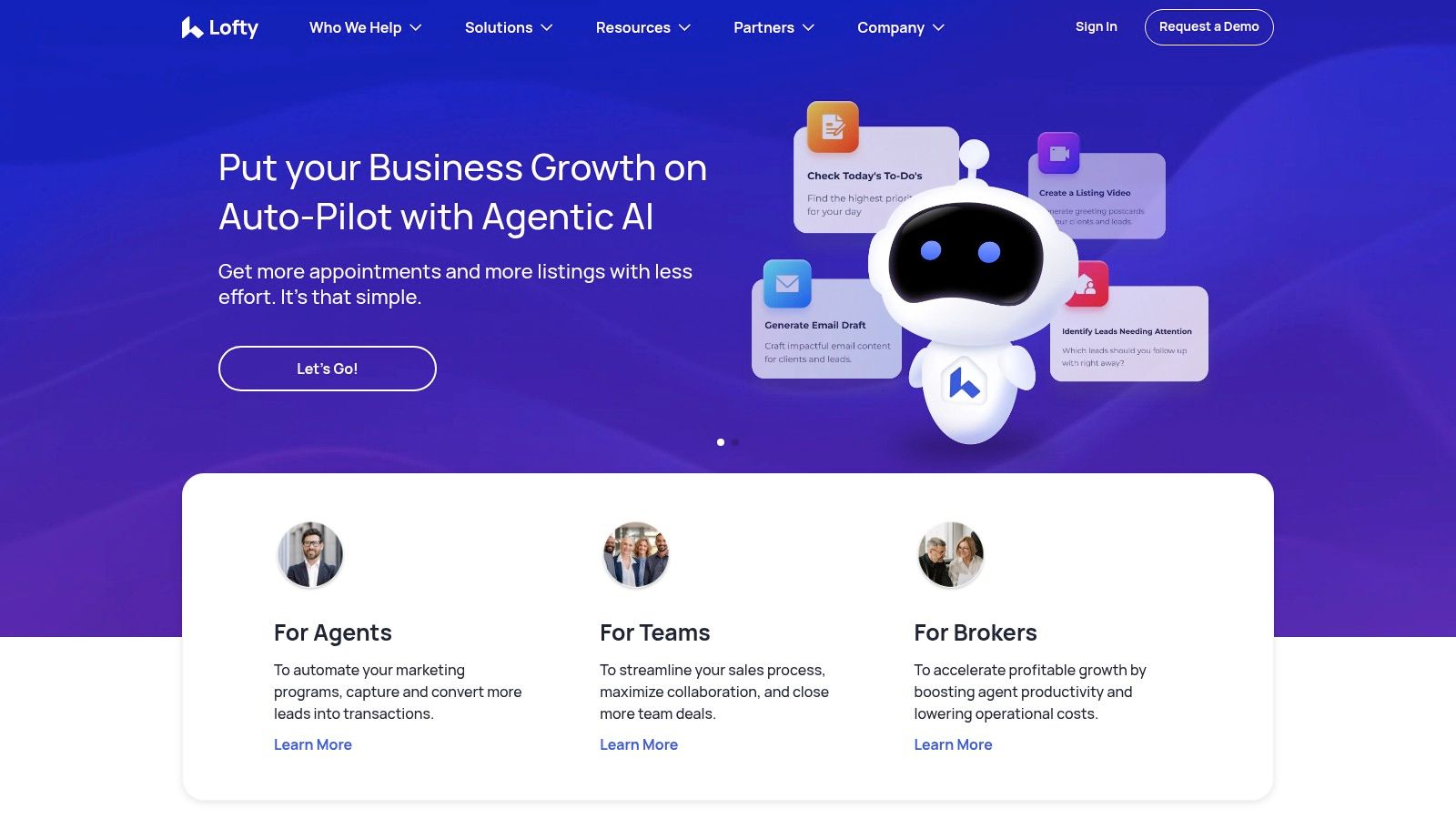
Chime is one of the cleaner answers for teams that want a single vendor for website, CRM, and AI-assisted nurture. That's its real appeal. It reduces the number of integration decisions you have to make up front.
Some teams outgrow point solutions before they realize it. They have one platform for the site, another for texting, another for routing, and then Zapier glue holding everything together. Chime makes sense when you want fewer moving parts and more standardized workflows.
Why Teams Choose It
Chime's AI Assistant, Smart Plans, mobile CRM, and IDX website stack create a practical all-in-one setup for growth teams. You can build structured follow-up around lead classification, repeatable plans, and team-wide templates without asking agents to bounce between systems all day.
That's the true productivity gain. Not “AI magic,” just fewer handoffs and fewer places for a lead to get lost.
If your team is already thinking in terms of process design, not just software features, this kind of stack pairs naturally with work on how to increase productivity with AI workflow design.
Where to Be Careful
Chime can simplify operations, but you need to verify exactly what's in the plan you're buying. Pricing and package details can vary, and sales-led quoting still plays a role. The Lofty branding references in some materials can also confuse teams during evaluation, especially if they're comparing older reviews to newer product positioning.
What I like most
- End-to-end stack: Less integration work than stitching together separate website, CRM, and AI tools
- Manager-friendly workflows: Smart Plans help standardize team behavior
- Operational consistency: Easier to train new agents when the stack is unified
What needs scrutiny
- Plan clarity: Confirm add-ons before assuming a feature is included
- Vendor dependence: Switching later is harder once your site and CRM both live there
4. kvCORE (Inside Real Estate / BoldTrail)
kvCORE from Inside Real Estate is brokerage-grade software. That distinction matters. Some tools work well for an independent team of a few agents. kvCORE is designed for organizations that need a wider operating layer across websites, CRM, lead generation, behavioral automation, marketing, and analytics.
When brokerages roll this out well, the benefit is standardization. Routing rules, nurture logic, lead engagement, and front-office tools can sit under one vendor. That reduces point-solution sprawl, which is a bigger problem than many leadership teams realize.
Best Use Case
kvCORE fits teams and brokerages that want one broad ecosystem and have enough operational maturity to manage it. If your leadership team can define rules, enforce adoption, and assign ownership, kvCORE gives you a lot to work with.
If you don't have that discipline, it can feel heavy fast.
That's why I usually see it as a fit for larger organizations, franchise groups, and teams with in-house operations support. It's also relevant for investors and operators exploring adjacent AI use cases, including AI for wholesaling real estate workflows, where centralized lead handling and behavior-based automation matter.
The Real Trade-Off
kvCORE can do a lot. That doesn't automatically mean it will feel simple.
- Advantage: Mature module coverage under one roof
- Advantage: Strong fit for brokerage-wide deployment
- Trade-off: More complexity than lighter CRMs
- Trade-off: Public pricing isn't straightforward, so procurement is usually sales-led
Brokerage leaders often overfocus on features. The real question is whether you have an operations owner who can keep the system clean after launch.
5. CINC (Commissions Inc.)
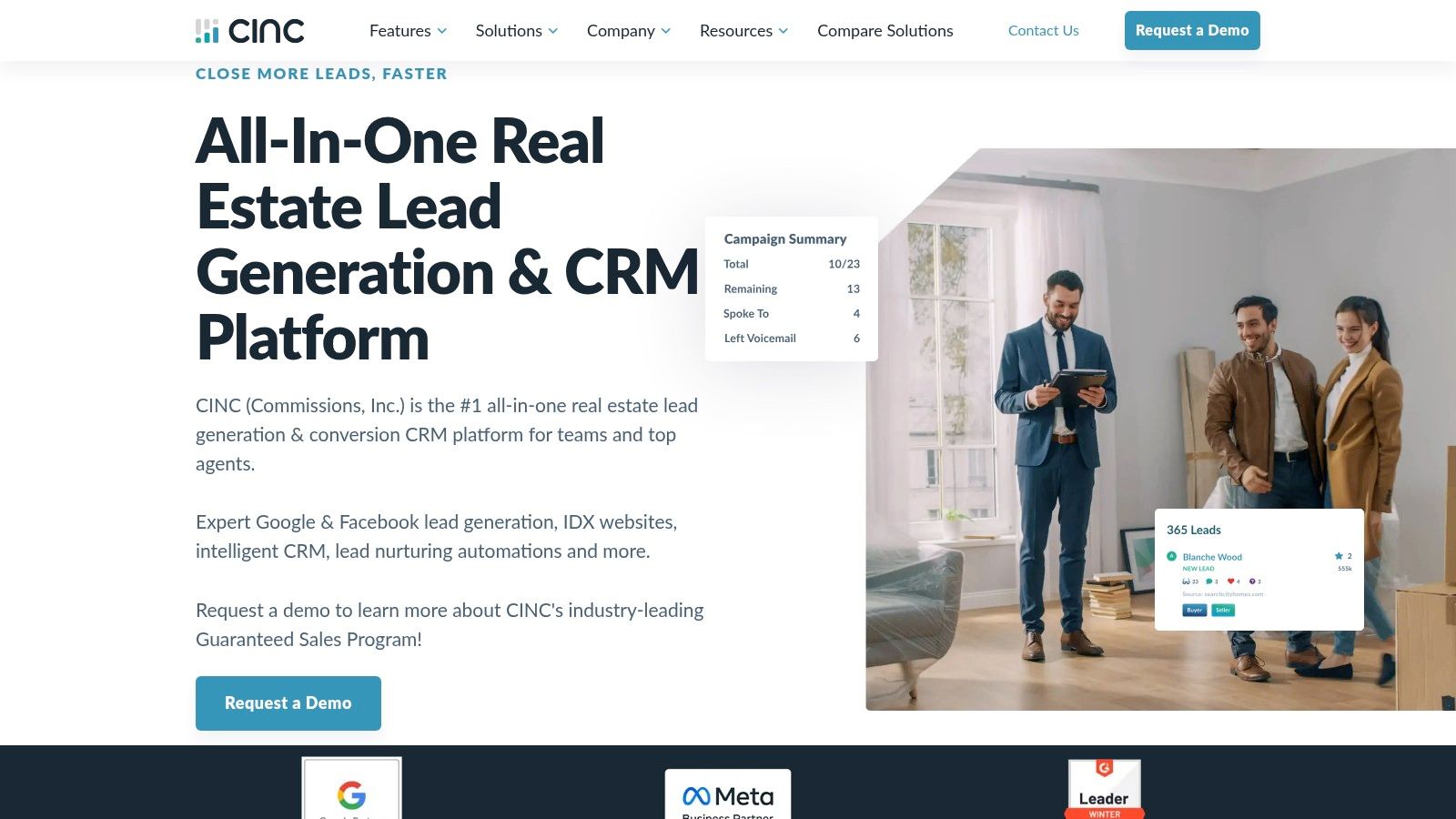
CINC has long appealed to teams that scale through paid lead generation and need a system built around structured conversion. It combines websites, CRM, calling, texting, video messaging, and ISA-style workflows. The newer AI layer extends that model rather than replacing it.
That's the right lens for CINC. It's a paid-lead conversion platform first, and an AI automation platform second.
Where CINC Delivers
If your team buys a lot of traffic and cares a great deal about immediate response, qualification, and handoff, CINC is built for that environment. CINC AI can slot into existing nurture frameworks, which is useful for teams that already have campaigns running and don't want to start from zero.
The platform makes more sense for mid-sized and larger teams than for solo operators. You're paying for structure, process support, and volume handling.
Where Teams Get Frustrated
The biggest issue isn't usually feature depth. It's whether the economics make sense for your pipeline. CINC pricing is often driven by add-ons, and the value only shows up if the team effectively uses the workflows with discipline.
I've also seen teams expect AI to fix weak lead strategy. It won't. If your paid traffic is broad, your routing is messy, or your messaging sounds generic, AI just helps you automate mediocrity faster.
Choose CINC if
- You're scaling paid lead volume: The platform is built around that motion
- You want ISA-style structure: Calling, texting, and qualification tools are core to the product
- You have a manager enforcing follow-up: Adoption drives the result
Be cautious if
- You want a low-cost setup: This usually isn't the budget option
- You dislike sales-led packaging: Expect quoting and add-on decisions
6. Sierra Interactive
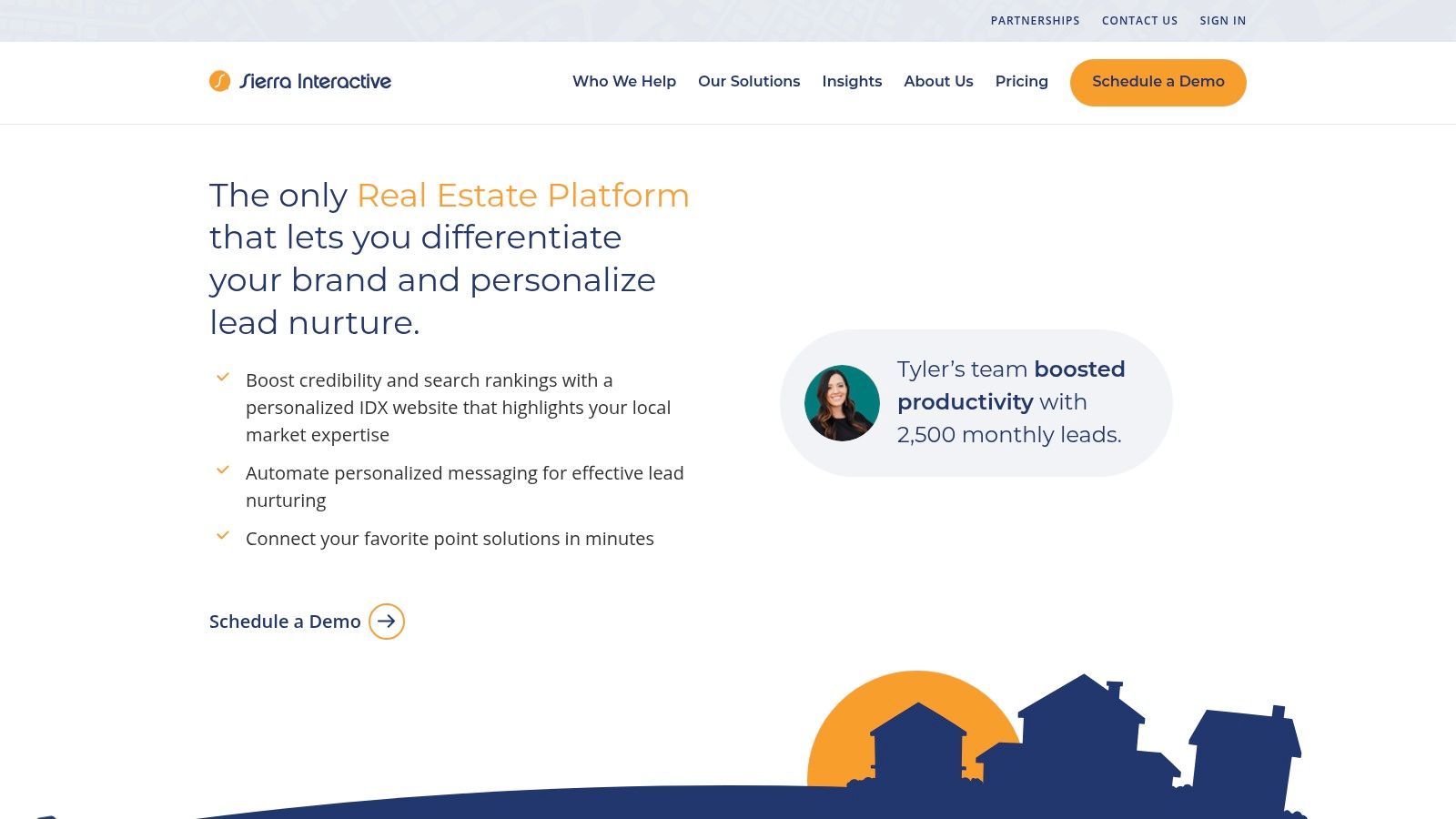
Sierra Interactive sits in a useful middle ground. It isn't as sprawling as the biggest enterprise suites, but it offers more than a narrow AI add-on. Teams that want an integrated website, CRM, action-plan automation, and an AI texting assistant often land here for a reason.
Its practical hook is Sierra AI. A native virtual ISA that handles two-way SMS can cover after-hours inquiries and keep conversations moving while the team is offline.
Why It's Attractive
A lot of platforms say they reduce tool sprawl. Sierra delivers on this for the right team. If you want one environment for your site, CRM, and lead qualification over text, it gives you that without feeling as enterprise-heavy as some competitors.
The built-in Action Plans are useful because they don't stop at email. You can automate call tasks, texts, voicemail drops, and follow-up structure in a way real estate teams can operationalize without a long implementation cycle.
Limits to Keep in Mind
The ecosystem is narrower than some larger suites, and public AI pricing details aren't very clear. That means you'll probably need a demo and quote process to understand the full cost and capabilities for your use case.
Sierra is a good fit when your team wants integrated texting AI and doesn't want to juggle multiple vendors just to cover nights and weekends.
I also like that Sierra has “Ask Sierra” for admin help inside the product. It won't drive ROI by itself, but tools that reduce friction for everyday users usually get adopted faster. In practice, that matters more than a long AI feature list.
7. Real Geeks
Real Geeks is one of the more practical value plays in this category. It combines an IDX website, CRM, marketing tools, mobile access, and a built-in AI texting assistant. For many teams, that's enough. They don't need the most enterprise-grade system. They need a stack they can afford, understand, and deploy without drama.
That's why Real Geeks tends to overperform in shortlists for smaller and mid-sized teams.
What It Gets Right
Its AI texting assistant, often referred to as Geek AI or Robin, helps with re-engagement and qualification over SMS. That gives teams a direct way to keep leads warm without asking agents to manually chase every stale contact.
The bigger strength is packaging. Real Geeks offers an all-in-one setup with published pricing and a relatively straightforward story. That may sound minor, but it's a real advantage when buyers are comparing five vendors and don't want every conversation to turn into a custom quote process.
Where It Falls Short
The app ecosystem isn't as broad as larger platforms, and some AI features may depend on the package. So while it's value-oriented, you still need to check what's included.
Why teams pick it
- Clearer pricing posture: Easier to evaluate without multiple sales calls
- Good enough all-in-one stack: Site, CRM, and AI texting cover the basics well
- Less operational overhead: Often easier to deploy than a heavier suite
Why some teams outgrow it
- Smaller ecosystem: Fewer enterprise-style extensions
- Less depth at the edges: Teams with complex routing or brokerage-wide needs may want more control
8. Verse.ai
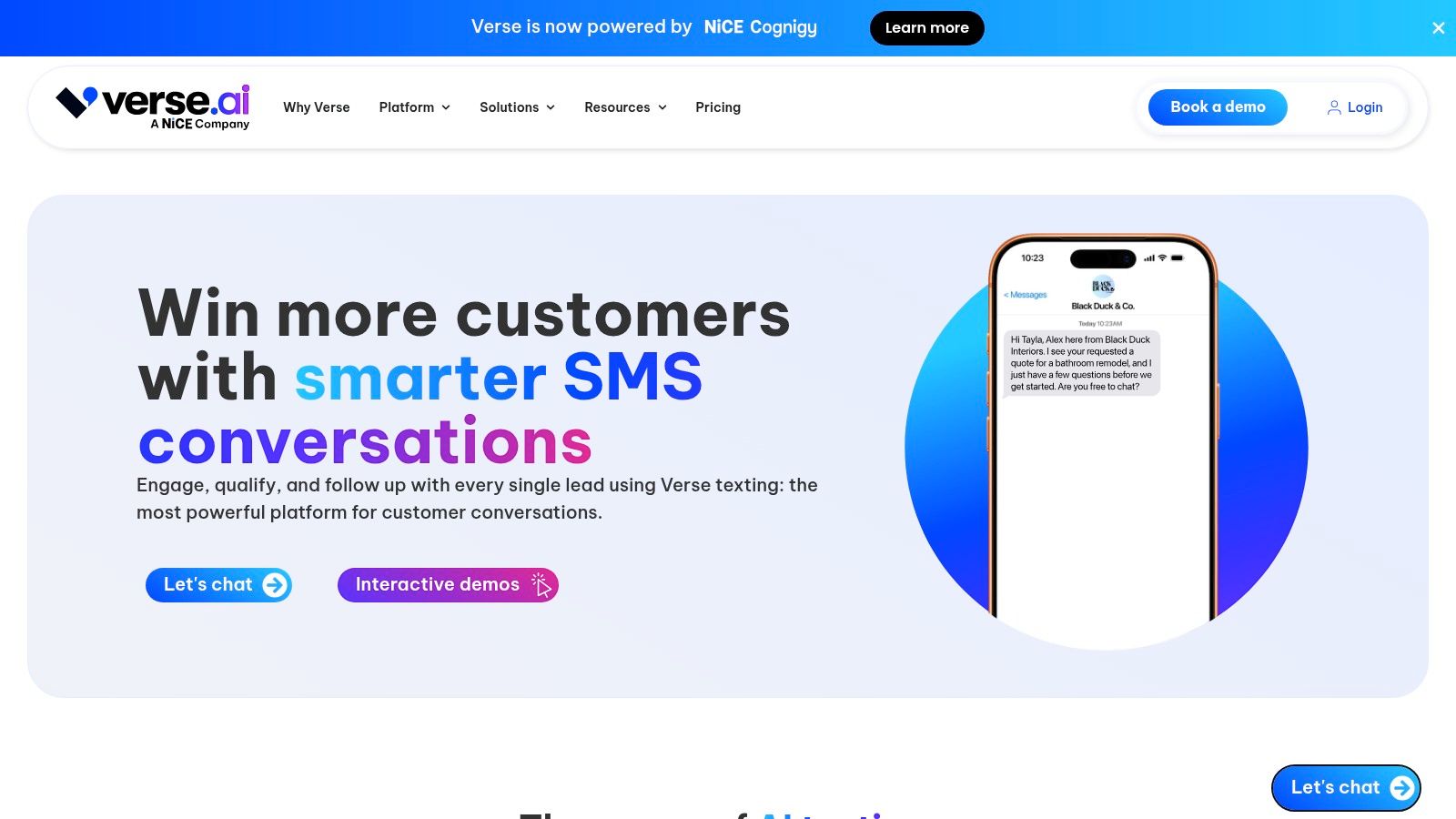
Verse.ai is one of the cleanest specialist picks on this list. It's not pretending to be your CRM, your IDX site, or your ad platform. It's an AI conversation layer built to qualify leads, nurture them over time, update the CRM, and help set appointments.
That narrower scope is a strength.
Best for Existing Stacks
If your team already likes its CRM and website, Verse is worth serious consideration. It can sit in front of your current setup and improve responsiveness without forcing a platform migration.
That makes Verse attractive for teams that know their bottleneck is follow-up quality, not system replacement. The deployment path is usually easier because you're plugging into the stack, not rebuilding the stack.
What to Watch
You still need the rest of the stack. Verse won't replace your CRM or your lead capture infrastructure. Pricing also tends to depend on volume and plan structure, and many teams will encounter annual commitments.
The broader reason specialist tools like Verse keep gaining traction is simple. Real estate teams want AI where it's most visible to prospects: conversation, qualification, and scheduling. The same pattern is showing up elsewhere in the industry. For example, AI-driven lease abstraction has cut work that used to take 4 to 8 hours down to 15 to 30 minutes with 95% to 99% accuracy, according to Re-Leased's roundup of real estate AI tools. Different use case, same buyer logic. Automate the repetitive front end so humans can handle the high-value moments.
9. Structurely
Structurely is for teams that want AI follow-up without changing their main systems. That sounds obvious, but it's still an underserved need. Many teams don't want another CRM migration. They want an AI sales assistant that can respond fast, qualify leads, create tasks, and keep the pipeline moving inside the tools they already use.
Structurely does that job well enough to stay relevant even when all-in-one suites are getting more aggressive.
What It's Good At
Structurely is purpose-built for real estate lead handling. It supports omnichannel outreach, round-the-clock replies, multilingual engagement, and task creation tied to lead intent. Optional AI calling and IVR flows add another layer for teams that want messaging plus voice coverage.
That makes it a strong complement tool. Not a replacement stack.
For teams evaluating messaging plus voice, it's also useful to compare specialist systems against broader AI voice assistant pricing for real estate agents, because cost structure and deployment model can change quickly once calls enter the mix.
The Bigger Issue
The biggest challenge with Structurely isn't product direction. It's fit. If you need a website, CRM, and marketing engine, this isn't the answer. If you already have those and just need better AI follow-up, it might be.
There's also a market-wide caution worth remembering. Compliance uncertainty is delaying adoption for 22% of real estate AI buyers, and only 3 major guides are noted as addressing legal frameworks in detail, according to AI Agent Brief's real estate coverage. Tools that send texts, route leads, or generate outreach need governance. Teams that ignore that usually slow themselves down later.
10. Roof AI
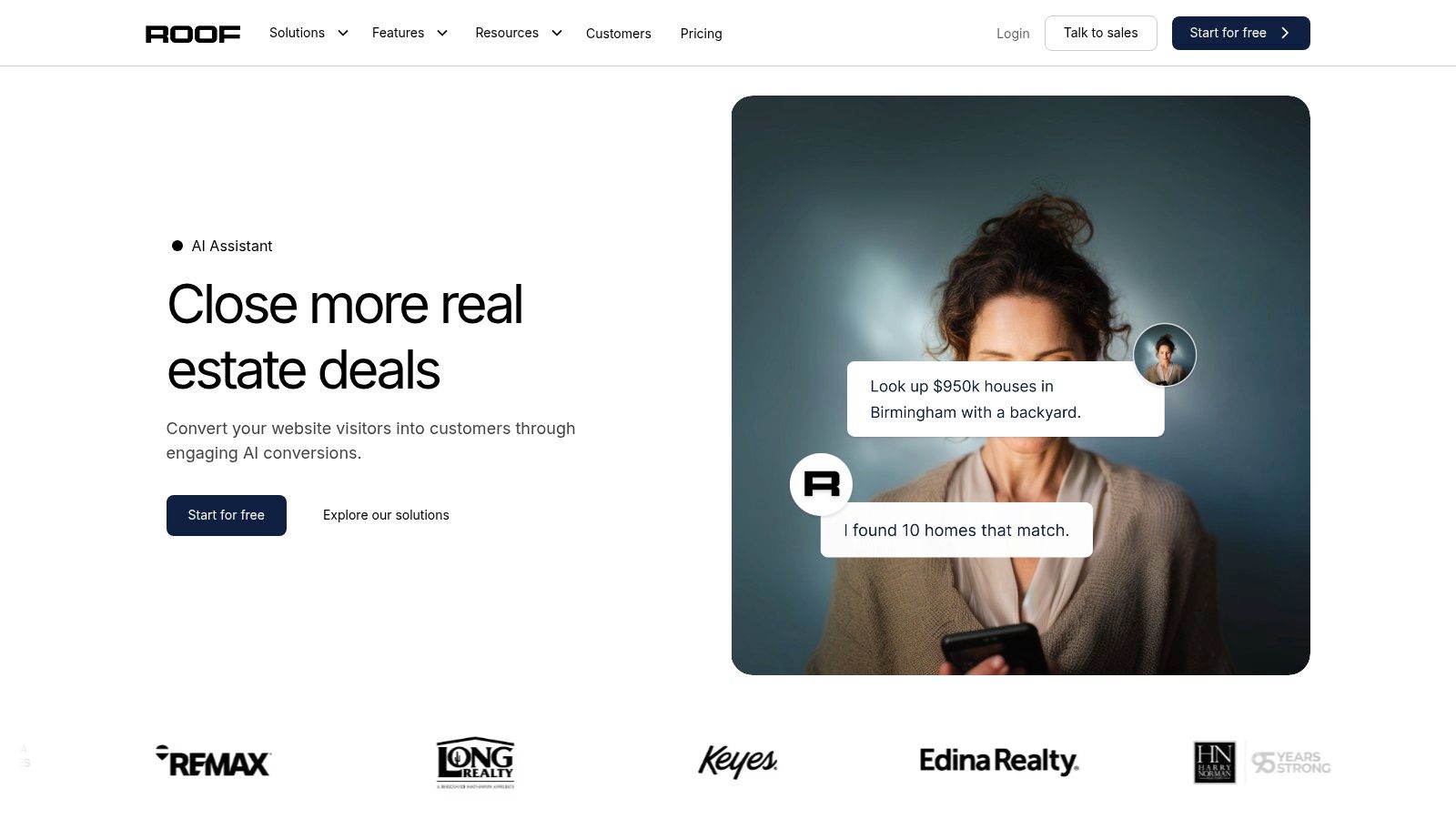
Roof AI is the most specialized tool on this list, and that's exactly why some teams should shortlist it first. It focuses on website conversation, listing-aware Q&A, lead capture, prioritization, and routing. If your biggest leak is on-site conversion, this is the category to look at.
A lot of platforms claim to “capture leads.” Roof AI is closer to an always-on website rep than a form replacement.
Best Use Case
Roof AI works for teams that already have a CRM and marketing stack but want smarter interaction on the website itself. It answers listing questions using MLS and IDX data, qualifies visitors in real time, and routes better opportunities to the right agent.
That's especially useful for brokerages with meaningful site traffic who don't want every inquiry to depend on a contact form or a delayed callback.
Why It's on This List
I like Roof AI because it's honest about what it is. It doesn't pretend to run your entire business. It handles a narrow but high-impact part of the funnel very well.
There's a broader trend behind that. Real estate data platforms now cover more than 136 million U.S. residential properties, which shows how far AI-backed property intelligence has scaled. Roof AI applies the same expectation at the website layer. Buyers and sellers increasingly expect immediate, context-aware answers, not static forms and generic autoresponders.
Use Roof AI when
- Your website gets traffic but under-converts: On-site conversation is the priority
- You already have a CRM: Roof AI is a front-end enhancement, not a full back office
- You want faster deployment: It's lighter than replacing your whole stack
Skip it when
- You need a full CRM suite: It won't replace your operating system
- You want deep voice automation: Its focus is website chat and routing
Top 10 AI Automation Platforms for Real Estate Teams
| Product | Core features | AI & lead handling | Best fit / Target audience | Pricing & deployment | Key differentiator |
|---|---|---|---|---|---|
| Follow Up Boss | Automations, calling/text, shared inbox, reporting | Embedded AI suggests CRM updates; workflow assist (some features tied to FUB Calling) | Teams standardizing process, speed-to-lead & accountability | Published plans; some AI tied to calling add-on | Simple, fast-to-adopt automation focused on agent activity |
| Ylopo | IDX sites, ads, retargeting, behavioral outreach | AI Text + AI Voice (AI²) 24/7 qualification and warm transfers | Teams needing always-on ISA-style automation tied to ads | AI² paid add-on; pricing opaque and volume-based | Ad + site + AI front-end with behavior-driven personalization |
| Chime | CRM, Smart Plans, IDX websites, marketing automations | AI assistant for 24/7 responses; auto lead classification synced to CRM | Teams wanting a single-vendor end-to-end stack | Sales-led pricing; features often add-ons | End-to-end stack that reduces integration work |
| kvCORE (Inside Real Estate) | IDX, smart CRM, marketing autopilot, analytics, integrations | AI behavioral automation for scoring, engagement, lead routing | Brokerages and enterprise roll-outs | Sales-led procurement; public pricing limited | Brokerage-scale platform with mature ecosystem |
| CINC (Commissions Inc.) | Lead gen + CRM, ISA tools, websites, messaging | CINC AI for instant responses and lead qualification | Mid-to-large teams focused on paid lead acquisition | Typically high; add-on driven pricing and quotes required | Purpose-built for paid-lead conversion at scale |
| Sierra Interactive | Website + CRM, Action Plans, voicemail drops | Sierra AI: 2-way SMS virtual ISA; in-app "Ask Sierra" support | Teams wanting integrated site, CRM, and native SMS AI | Demo/quote required; limited public AI pricing | Native SMS agent + fully automated action plans |
| Real Geeks | IDX websites, CRM, mobile app, marketing tools | Geek AI ('Robin') SMS assistant for auto-engage & nurture | Value-oriented teams wanting site + CRM + AI texting | Published plans; AI included in some packages or as add-on | Competitive pricing for an all-in-one stack |
| Verse.ai | Conversational AI, CRM & calendar integrations, playbooks | 24/7 SMS conversations, long-term nurture, scheduling integrations | Teams that want an AI front-end to plug into existing CRM | Volume-based pricing; annual terms common | Quick deployable conversational layer with enterprise integrations |
| Structurely | Omnichannel AI assistant, task creation, multilingual support | 24/7 SMS & email replies, long-term nurture, optional AI calling/IVR | Teams wanting AI follow-up without replacing CRM/website | Quote-based; public pricing sparse | CRM-agnostic AI sales assistant that creates tasks & reminders |
| Roof AI | Website chat assistant with MLS/IDX data integration | Property-aware Q&A; capture, prioritize & route leads to agents | Teams wanting smarter on-site conversion and triage | Transparent pricing for chat deployment; lightweight install | MLS/IDX-trained chat focused on on-site lead qualification and routing |
Making Your Choice and Next Steps
Choosing the best AI automation platform for real estate teams isn't really about choosing the platform with the longest feature list. It's about choosing the one that matches how your business already runs, or how you realistically want it to run in the next year.
If you want the simplest buying framework, break the market into three buckets. All-in-one platforms like Chime, kvCORE, CINC, Sierra Interactive, and Real Geeks make sense when you want to consolidate website, CRM, and automation. CRM-centered systems like Follow Up Boss work better when you already like your lead sources and website stack but need better process discipline. Specialist assistants like Verse.ai, Structurely, Ylopo, and Roof AI fit teams that want AI in a specific part of the funnel without replacing everything.
The second decision is team readiness. Smaller teams often overbuy. They sign up for a broad platform and then use a fraction of it. Larger teams often do the opposite. They keep layering point solutions until no one trusts the data and every lead handoff feels fragile. The right answer usually sits between those two mistakes.
There are also technical and compliance realities that deserve more attention during selection. If you're handling lead qualification, outreach, routing, or transaction-adjacent data, ask hard questions about consent rules, CRM syncing, audit trails, and who owns workflow governance after launch. This is one reason many teams hesitate with AI in the first place. In adjacent real estate workflows, AI transaction management platforms such as ListedKit and Trackxi are cited as processing contracts 4X faster with 95%+ accuracy, while AVMs are cited with error rates below 2.8%, according to Planetary Labour's analysis of AI agents in real estate. The takeaway isn't that every tool performs the same. It's that serious automation now belongs in production workflows, provided teams implement it with controls.
A simple implementation plan works better than a grand rollout:
- Define one primary goal: Pick the first outcome that matters most, such as faster lead engagement, better qualification, cleaner routing, or more appointments held.
- Clean the database first: Bad tags, duplicates, and dead numbers will pollute every automation you launch.
- Train agents on the exact workflow: Don't just give access. Show them what happens when a lead replies, when AI hands off, and when humans take over.
- Assign an owner: Someone has to review conversations, monitor routing, update templates, and catch edge cases.
- Track operational behavior, not just outcomes: Watch response handling, handoff quality, contact rates, and stage progression before you obsess over closed deals.
For larger brokerages or operators with unique workflows, a custom build can be the smarter path. That's especially true when off-the-shelf products don't match your routing logic, reporting requirements, compliance needs, or internal systems. A partner like AmasaTech can help design proprietary AI around business KPIs instead of forcing your process into a generic SaaS workflow.
The point of all this isn't to replace agents. It's to remove the repetitive work that slows them down. The right AI platform gives your team leverage. It responds faster, qualifies better, routes cleaner, and frees your people to do the part software still can't do well: build trust and close deals.
Book demos with your top two choices this week. Don't ask for a generic walkthrough. Bring your actual workflow, your current stack, and your biggest leak in the funnel. That's where the right decision becomes obvious.
If your team needs more than an off-the-shelf tool, AmasaTech can help you design and deploy AI around the outcomes that matter, including throughput, accuracy, cost, and revenue impact. That's useful when you need custom lead routing, document intelligence, agentic workflows, compliance-aware automation, or a secure enterprise rollout that ties directly to business KPIs rather than generic software usage.