
A realistic MVP budget for the first 3 to 6 months usually lands between **$5,000 and $25,000. The mistake is thinking that number is the whole story, because variable costs like discovery work and API usage can push overall spend much higher if you don't control them early.
A lot of advice on startup costs for an AI automation agency tries to give you one clean number. That's comforting, but it isn't how this business works. You aren't opening a coffee shop with fixed inventory and predictable foot traffic. You're stitching together people, tools, cloud services, client expectations, and usage-based AI systems that can look cheap at proposal stage and expensive after launch.
The founders who stay solvent usually do one thing better than everyone else. They budget for what the spreadsheet doesn't show at first glance. That means planning for pre-sales diagnostics, post-launch tuning, and the ugly reality that a chatbot people use can cost more to run than the demo implied.
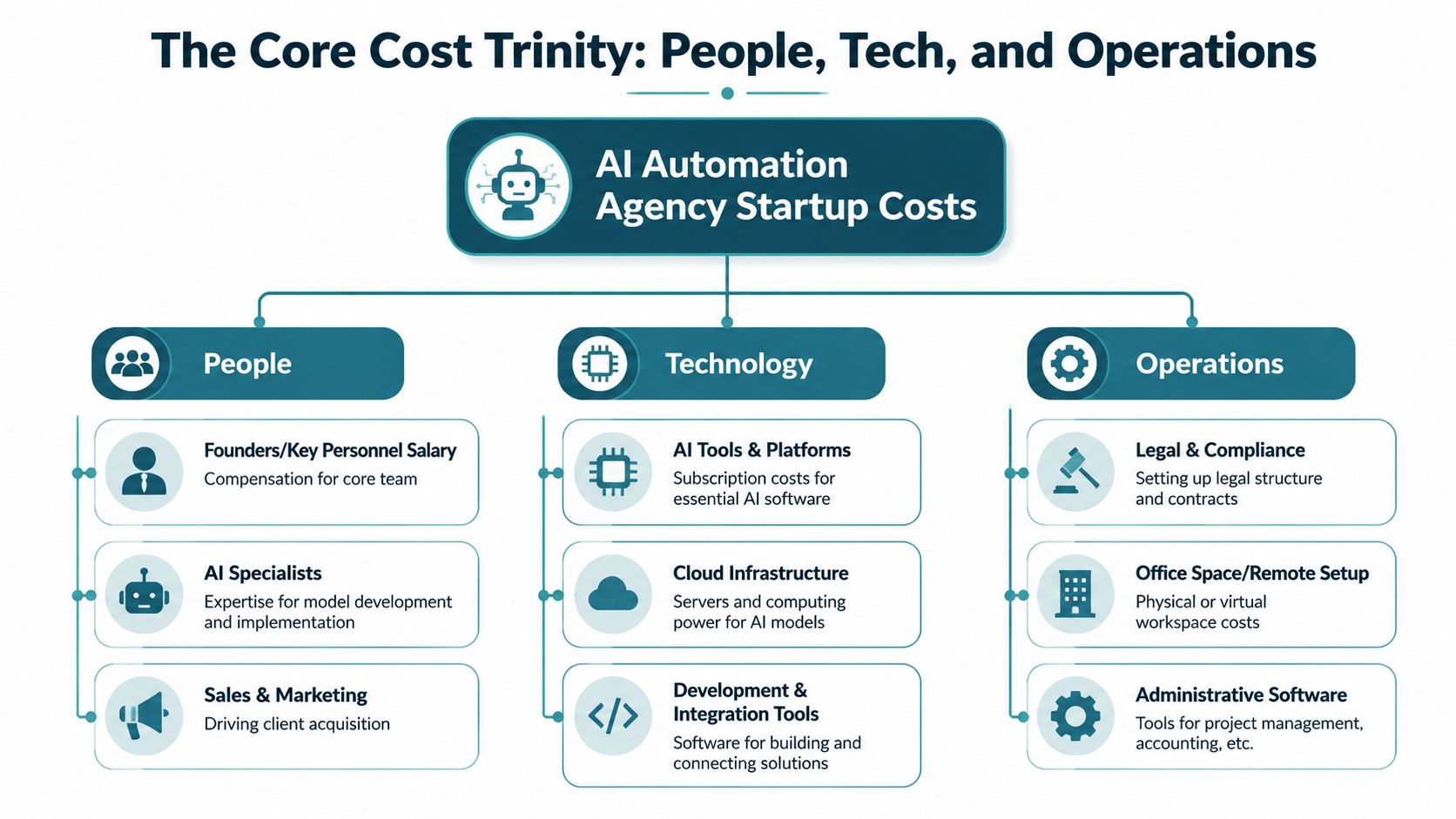
The Core Cost Trinity People, Tech, and Operations
The first budgeting mistake is over-focusing on model choice. Your startup lives or dies on three simpler categories first: people, technology, and operations.
Before you worry about agent frameworks, think about who will build, who will sell, and who will keep delivery from turning into chaos. Most new agencies don't need a research scientist on day one. They need someone who can scope workflows, integrate APIs, build reliable automations, and talk to clients without creating false expectations.
People costs come first
If you're starting lean, the strongest early team usually looks less glamorous than people expect.
- A founder who can sell and diagnose problems: If nobody can run discovery calls and translate business pain into an implementation plan, the agency stalls before delivery even begins.
- A builder with broad integration skills: Early on, a versatile full-stack operator who understands APIs, prompt workflows, RAG basics, Zapier, Make, n8n, and common SaaS integrations often beats a narrowly specialized ML profile.
- Part-time support instead of premature hiring: Bookkeeping, design, and even some implementation work can stay contract-based until the pipeline is steady.
A lot of first-time founders hire technical depth before they have repeatable demand. That's backwards. The first bottleneck is usually pipeline and scoping, not model architecture.
Practical rule: Hire for problem diagnosis and implementation reliability before hiring for cutting-edge AI novelty.
Tech costs are broader than AI subscriptions
Your software stack starts with AI tools, but it doesn't end there. A working agency usually needs a CRM, proposal tooling, project management, internal documentation, cloud accounts, version control, monitoring, and some way to test safely before pushing automations into a client's live workflow.
You also need to distinguish between tools that help you build and tools that become part of the client solution. Founders often mix these together and then can't tell whether a client is profitable.
A practical starter stack often includes:
| Category | What it covers | What to watch |
|---|---|---|
| Delivery stack | Automation platforms, LLM access, databases, integrations | Usage-based billing can change fast |
| Sales stack | CRM, outreach, proposal workflows, call recording | Easy to overbuy before revenue is consistent |
| Internal stack | Project management, documentation, QA, password management | Small recurring costs stack up quietly |
If you're still validating your offer, keep the stack boring. Fancy tooling doesn't fix weak positioning.
For teams that want a structured way to assess what tech and process gaps exist before spending heavily, AI readiness consulting is the kind of engagement model worth studying.
Operations are the costs founders delay too long
Legal setup, contracts, insurance, accounting, and tax support don't make your agency stand out. They do keep one bad client or one messy dispute from wrecking your year.
The same goes for security hygiene. Even if you're selling to smaller businesses at first, clients will ask basic questions about data handling, access control, and where their information flows. If your answer is improvised, sales gets harder and delivery gets riskier.
Use this checklist early:
- Legal foundation: Entity setup, client contracts, contractor agreements, and data processing language.
- Financial controls: Bookkeeping, invoicing discipline, and clean separation of personal and business spend.
- Operational hygiene: Password management, access permissions, offboarding procedures, and documented delivery steps.
Startup costs for an AI automation agency look manageable on paper when you leave out these basics. In real life, these basics are what keep the agency functional while you chase growth.
Beyond the Obvious Uncovering Hidden AI Agency Costs
Founders rarely blow the budget on Zapier, hosting, or a chatbot widget. They blow it before the build starts, during diagnosis, and after launch, when usage starts drifting beyond the neat estimate in the proposal.
Those are the costs that make a promising AI automation agency look profitable on paper and frustrating in practice.
The diagnostic phase is where underquoting starts
A lot of new agency owners treat discovery like a sales expense. That is one of the fastest ways to train clients to expect free consulting and to train yourself to underprice delivery.
Real diagnostic work is not a quick intake call. It means tracing how work moves through the client's business, where humans intervene, what data is missing, which systems break, who owns approvals, and what failure looks like in day-to-day use. Until that is clear, the quote is a guess.
As noted in this analysis of AI automation cost and hidden overhead, agencies that skip or undercharge for discovery often miss the cost of the diagnostic phase and get hit later by both scope creep and rising usage fees. That is why serious operators separate diagnosis from implementation instead of burying it inside the project fee.
I learned this early. The clients who push hardest to skip paid discovery are often the same clients with messy processes, unclear ownership, and changing requirements. They are not cheaper to serve. They are more expensive.
A better diagnostic phase does four jobs:
- Maps the current workflow: Find triggers, dependencies, exceptions, and manual checkpoints.
- Finds integration risk early: Old CRMs, broken data fields, and undocumented workarounds change the build cost fast.
- Sets success metrics before scoping: Quote against response time, throughput, conversion, deflection, or accuracy, not vague promises.
- Creates a paid decision point: The client can stop after diagnosis, or move into implementation with a clearer scope.
Bad discovery does not just cut margin. It creates projects that were scoped too loosely to deliver well.
For founders who want to understand why model behavior, training choices, and system design can change delivery cost so quickly, this guide to neural network training gives useful technical context.
Token bleed is what turns a clean pilot into a messy margin problem
The second hidden cost is what operators call token bleed.
It starts small. Prompts get longer. Retrieval pulls too much context. Users ask broader questions than expected. The team adds retries, summaries, fallback steps, memory, and logging. Then the monthly API bill climbs without any single decision looking reckless on its own.
That is why a pilot can look healthy while the production version disappoints. A demo flow with one controlled prompt is cheap. A real client workflow with live traffic, edge cases, and layered logic is not.
Inexperienced agencies often get trapped. They price the build, ignore consumption behavior, and discover later that support tickets, overages, and unpredictable usage have wiped out the margin. In the worst cases, a small fixed-fee project becomes a long-term delivery burden because the contract never set limits on how much model usage the client could create.
How to control usage before it controls your margins
- Keep prompts tight: Standardize prompt structure and remove bloated instructions that add cost without improving output.
- Limit context on purpose: Retrieval and memory should be scoped to the task. More context is not automatically better.
- Route with cheaper logic first: Use rules, validation, and lightweight classifiers before sending every action to an LLM.
- Write usage terms into the contract: Define included volume, overage pricing, response boundaries, and support scope.
- Review logs early: Watch for repeated retries, long context windows, and user behaviors that trigger unnecessary calls.
The hidden cost here is not just the API line item. It is unpredictability. If you cannot explain what drives consumption, you cannot price retainers cleanly, protect margin, or forecast growth with confidence.
Startup costs for an AI automation agency are not just setup costs. They include the price of learning what the client really needs, and the price of every model call that follows.
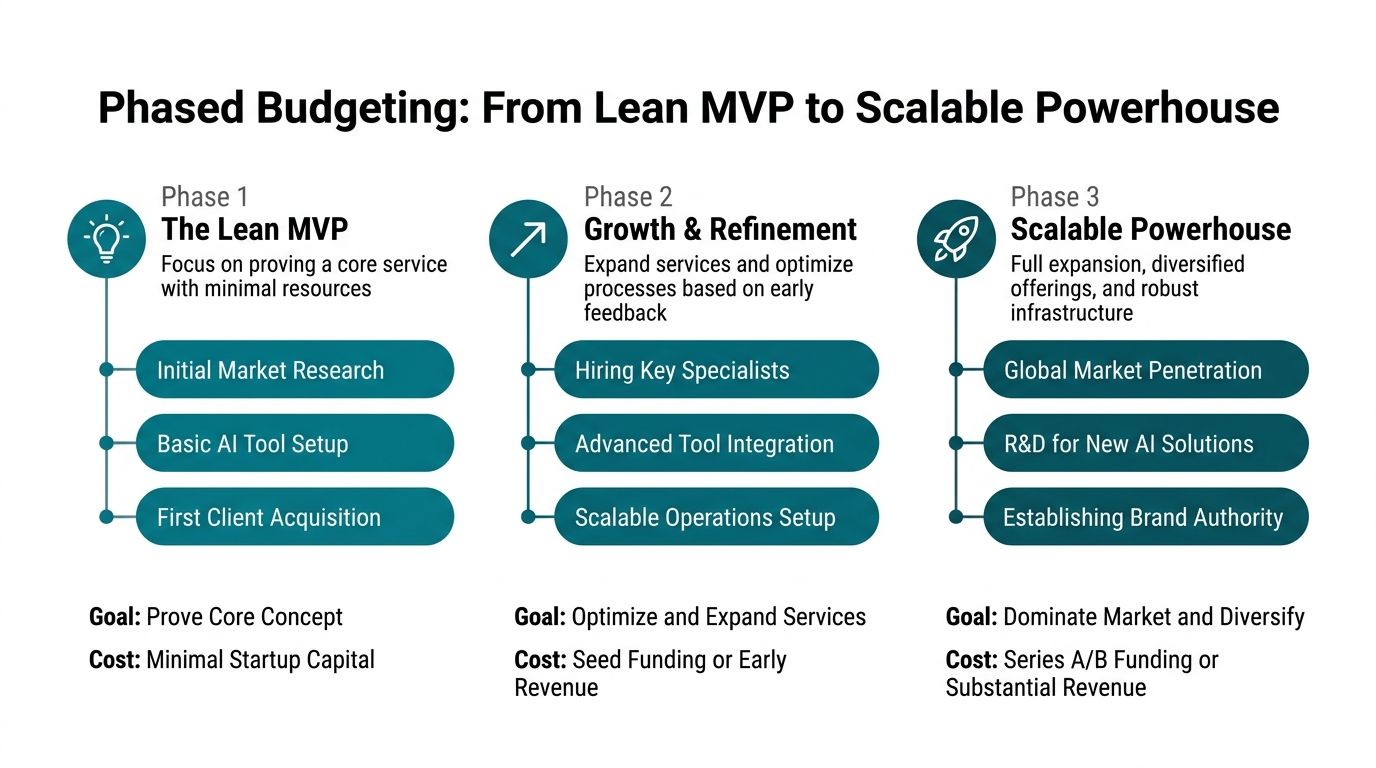
Phased Budgeting From Lean MVP to Scalable Powerhouse
A lot of new agency founders overbudget the wrong phase. They plan for hiring, branding, and fancy tooling before they have proof that one offer sells and delivers cleanly. The true early expense is usually narrower and less visible. It is the time and labor required to diagnose the client's process well enough to automate the right thing.
That is why phased budgeting works. It forces spending to follow delivery reality, not ambition.
Phase one is the lean MVP
The first phase should fund one repeatable offer, a small tool stack, and enough runway to survive slow sales cycles. Keep the scope tight. A lead qualification bot, support triage workflow, internal knowledge assistant, or reporting automation is usually enough to test whether a niche will buy from you.
Early on, the hidden line item is diagnostic work. Before the build starts, someone has to map the client's current workflow, identify exceptions, check data quality, and figure out where AI is useful versus where simple rules will do the job. Founders regularly underprice this part because it feels like pre-sales. In practice, it is delivery work, and if you do not budget for it, margin disappears before the first automation goes live.
A lean phase usually holds up better when you do three things well:
- Sell one outcome: Phrase the offer around a business result, not a pile of features.
- Reuse your delivery method: Keep the same onboarding questions, templates, QA steps, and model patterns across clients.
- Put limits around custom work: Edge cases multiply fast, especially during discovery.
If you want a practical framework for sequencing capability, delivery maturity, and spend, this AI adoption roadmap for staged implementation is a useful reference.
Phase two is growth and refinement
Once the offer closes and delivers consistently, budget should go toward throughput and control. This is usually the phase where agencies add better documentation, project management discipline, QA checklists, client reporting, and light support on sales or account management.
The mistake here is expanding too early. A few successful projects can make a founder believe the market wants a full menu of AI services. What happens is more expensive. Sales conversations get harder, scoping gets fuzzier, and every project starts to carry its own logic, integrations, and support burden.
Use this stage to strengthen the operation you already know how to run.
| Growth decision | Good use of budget | Bad use of budget |
|---|---|---|
| Hiring | Delivery support or sales help tied to active demand | Senior specialists before pipeline is stable |
| Tooling | Monitoring, documentation, testing, and repeatable deployment workflows | Expensive platforms with no client-backed use case |
| Marketing | Niche positioning, case studies, and proof assets | Broad brand campaigns before the offer is proven |
This is also where usage economics start to matter more. One client with heavy interaction volume can change your monthly cost profile fast. If phase one proved demand, phase two needs to prove that the offer still works after real-world usage, revisions, retries, and support requests are added.
Phase three is where costs can spike hard
By this point, some agencies move into larger multi-system implementations or advanced agentic builds. That can work well, but only if the business is already set up for longer discovery cycles, tighter technical QA, enterprise security reviews, and post-launch support.
According to Sparkout Tech's breakdown of AI agent development costs, development for enterprise-grade agentic systems can rise to $80,000 to $300,000+ per deployment, with an additional $15,000 to $40,000 setup cost and $500 to $3,000 per month for managed vector database storage and pipelines.
Those numbers are high for a reason. The expensive part is rarely just model integration. It is orchestration logic, testing across edge cases, tool reliability, memory design, permissions, and all the work needed to stop a smart-looking demo from failing in production. The diagnostic phase gets heavier here too, because enterprise clients usually have messier systems, more stakeholders, and more exceptions than they admit in the first meeting.
Complexity should be earned.
A practical budget should match the stage of agency you are running. In the beginning, protect cash and prove one offer. In the middle, buy efficiency and control. At the top end, assume discovery will take longer, delivery will be less predictable, and variable usage costs can punish weak pricing if you have not built contracts and margins for that reality.
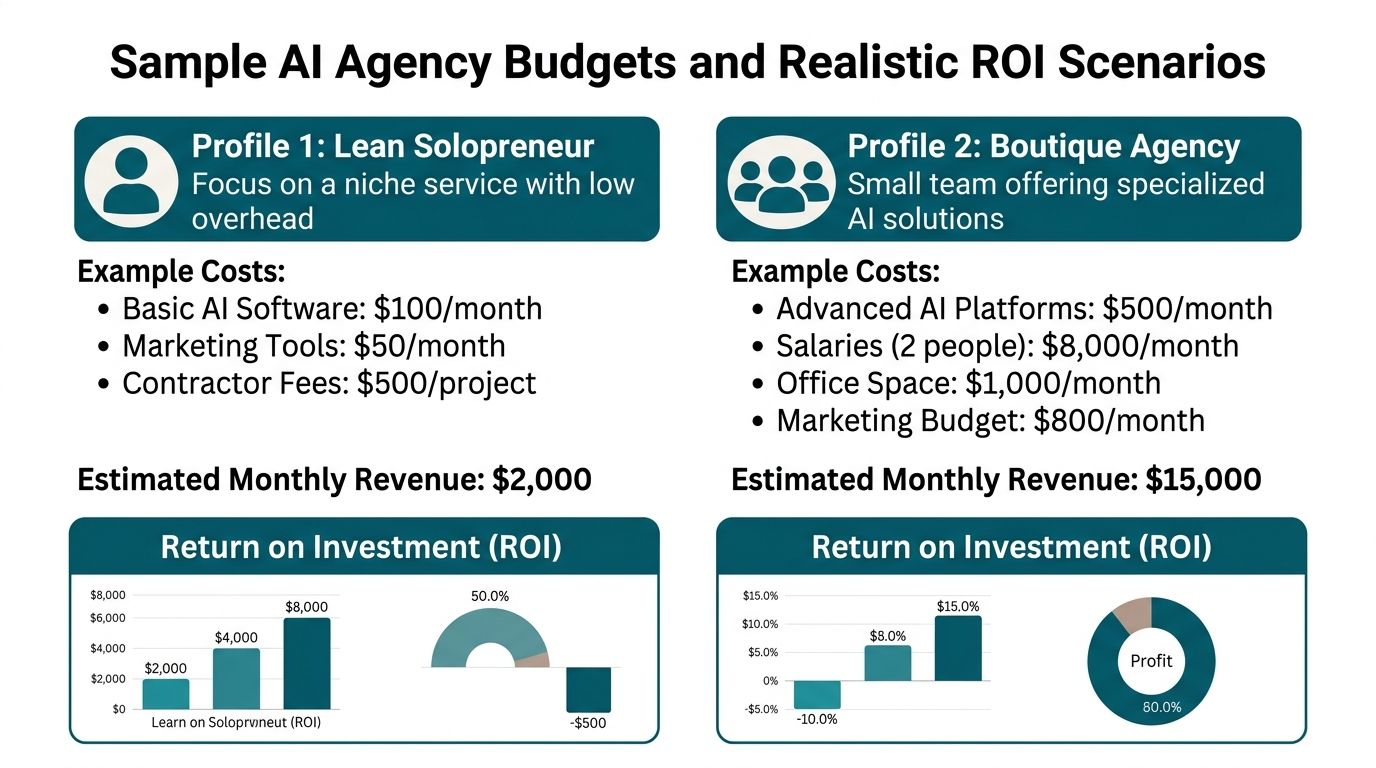
Sample AI Agency Budgets and Realistic ROI Scenarios
Budget examples are useful only if they reflect how AI work is sold and delivered.
A new agency does not fail because the spreadsheet was sloppy. It fails because the founder priced the visible build and ignored the diagnostic phase, client hand-holding, and usage volatility that show up after kickoff. That is why sample budgets need to be tied to client type, delivery model, and margin tolerance.
Budget ranges by client type
According to TaskIP's 2026 AI automation agency cost breakdown, small businesses automating 2 to 3 workflows typically budget $1,000 to $3,500 for initial setup. The same source says mid-market businesses planning multi-workflow AI stacks should expect $4,000 to $10,000 for setup, while enterprise builds can reach $25,000 to $100,000+. TaskIP also notes that teams often reserve an additional 10% to 20% of the initial setup budget for optimization during the first 3 months.
Use those numbers carefully. They are client-side spending ranges, not guaranteed agency margins.
A small business project with a $2,500 setup fee can still be a bad deal if you spend too many unpaid hours in discovery, custom prompt testing, revision rounds, and post-launch support. I have seen founders celebrate a signed deal, then realize they built themselves a part-time support job with almost no profit left.
| Agency profile | Best-fit market | Budget logic |
|---|---|---|
| Lean solo operator | Small businesses with a few workflows | Low overhead works only with tight scope, short diagnostics, and repeatable delivery |
| Boutique specialist team | Mid-market clients with multiple workflow needs | More revenue per deal, but higher PM, QA, documentation, and support costs |
| Enterprise-focused agency | Complex, cross-department deployments | Larger contracts, longer sales cycles, heavier discovery, and slower cash collection |
What realistic ROI thinking looks like
ROI for an AI automation agency is rarely clean in the first year. The sales math looks simple. Delivery reality usually is not.
Start with three questions that expose whether an offer can hold margin:
- How many paid diagnostics or projects do you need each month to cover fixed costs?
- How often does a "simple" implementation turn into extra workflow mapping, prompt iteration, or integration cleanup?
- How exposed is your pricing to API and token usage changing after the client starts using the system at real volume?
That third question gets missed all the time. A workflow can look profitable in a demo environment, then become expensive once real users upload larger files, trigger more fallback calls, or ask longer questions than expected. If your contract charges a flat fee while your model and automation costs rise with usage, margin slips fast.
Small business offers usually reward speed and standardization. Mid-market offers can produce better account value, but only if your onboarding, reporting, and support process is mature enough to keep delivery from becoming custom consulting every time.
For founders modeling revenue, client payback, and service profitability, this AI ROI calculator guide is a useful planning tool.
A more honest way to budget your first agency
Build the budget in three layers:
- Base operating budget: People, software, legal, admin.
- Delivery budget: Labor, tools, model usage, and workflow infrastructure tied to active client work.
- Volatility buffer: Extra diagnostics, rework, optimization, support load, and API overruns.
The volatility buffer is where early budgets usually break. Founders often account for the build and underprice the diagnostic phase, especially when the client's real process only becomes clear after access is granted and stakeholders start contradicting each other.
The same problem shows up in token consumption. Early estimates are often based on test prompts and light traffic. Production usage is messier. Message length expands, retrieval calls stack up, exceptions trigger retries, and costs rise in places the original proposal never priced.
A realistic budget assumes some uncertainty from the start. That does not make the business less attractive. It makes the pricing more honest.
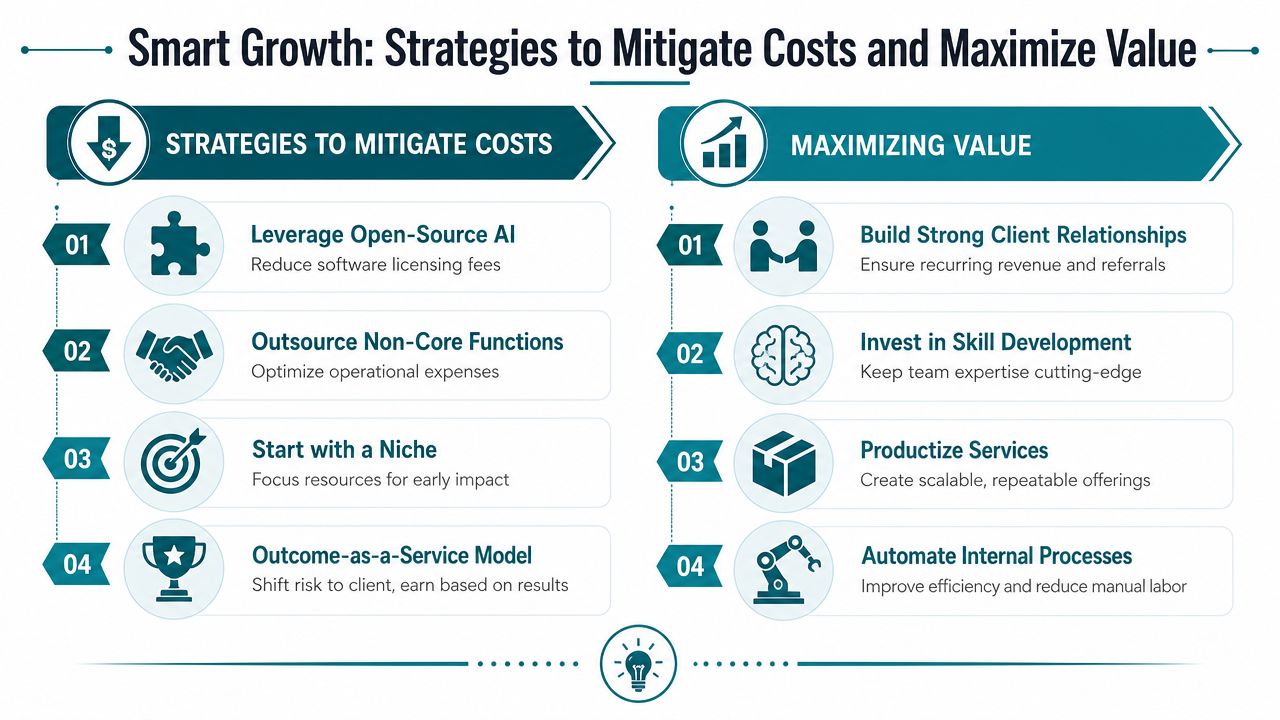
Smart Growth Strategies to Mitigate Costs and Maximize Value
The best AI agencies aren't always the ones with the deepest pockets. They're the ones that make cleaner strategic choices early.
If you want margin, stability, and room to grow, focus on business design, not just tool selection. The wrong pricing model, the wrong client segment, or the wrong delivery promise can make even a technically strong agency feel underfunded all the time.
Productize before you customize
The fastest way to burn time is to treat every project like a one-off consulting masterpiece. That's fun for your ego and bad for your operations.
Start with productized services built around repeatable problems. A lead handling workflow, a support assistant, a document intake process, or a knowledge retrieval system can all be packaged with a standard onboarding path, standard deliverables, and clear support terms.
That does three things:
- Cuts delivery variance: Your team isn't rebuilding the same logic from scratch.
- Improves pricing discipline: You sell a known outcome, not an undefined blob of effort.
- Makes quality easier to maintain: Repetition exposes weak spots quickly.
Agencies usually don't become profitable by adding more service lines. They become profitable by making the same service easier to sell and easier to deliver.
Use partnerships to avoid premature payroll
A lot of capability can stay outside your payroll in the beginning. Security review, niche compliance guidance, advanced data engineering, and UX work can all be handled through trusted partners until volume justifies internal hires.
Payroll creates pressure. Once it's there, founders often take poor-fit work just to keep utilization up.
A smarter setup is to keep a bench of specialists you can pull in only when the project requires it. That lets you stay credible in sales without carrying every skill full-time from the start.
Choose pricing models that protect margin
Time-and-materials billing is easy to start with, but it often punishes efficiency. If your team gets better, you earn less for the same value.
A stronger long-term move is to tie pricing to a defined scope and a business result. That doesn't mean making reckless guarantees. It means pricing around measurable outcomes the client cares about, then building your delivery around those metrics.
At this stage, many founders mature from "we install AI tools" to "we improve a business process." The second position is more defensible and usually easier to retain.
Be deliberate about cloud dependence
Cloud services are the default for a reason. They're flexible, fast to launch, and easier for a small team to manage. But not every workload should stay indefinitely on a pure pay-as-you-go model.
For some recurring workloads, especially where usage becomes predictable, it can make sense to evaluate alternatives to constant variable billing. The right answer depends on the workload, data sensitivity, latency requirements, and your team's operational ability. The key point is to make that choice consciously, not by habit.
For practical ways to reduce orchestration and implementation spend without lowering quality, these cost-saving strategies for AI orchestration services are worth reviewing.
Keep one eye on client value and one eye on internal drag
Founders often obsess over client-facing delivery and ignore internal waste. Manual QA, unclear handoffs, weak documentation, duplicated prompts, and inconsistent project setup all raise costs subtly.
You don't need a giant ops team to fix that. You need discipline.
Use a simple internal review loop:
| Area | Question to ask |
|---|---|
| Sales | Are we closing the right projects, or just the available ones? |
| Delivery | Are we repeating work that should already be templated? |
| Support | Are post-launch requests exposing bad scoping or weak onboarding? |
| Finance | Can we tell which services actually produce healthy margin? |
The core lesson behind startup costs for an AI automation agency is straightforward. Visible costs get attention. Hidden costs decide whether the business holds together.
If you're planning an AI automation agency and want help turning rough ideas into a budget, service model, and rollout plan that won't collapse under hidden costs, AmasaTech is a strong place to start. Their approach begins with a deep AI audit, maps quick wins against longer-term initiatives, and structures delivery around measurable business outcomes instead of vague experimentation.